Commercial vs. Residential Gutters: Sizing, Profiles, and Materials
When your commercial property starts showing water damage, finding commercial gutter companies near me fast can mean the difference between a minor repair and a major structural headache.
Here’s what to look for when hiring a commercial gutter company:
- Licensing and insurance — verify general liability and worker’s compensation coverage
- Commercial experience — not just residential; commercial roofs shed 3 to 10 times more water
- In-house crews — no subcontractors means better quality control
- Written estimates — upfront pricing with no hidden fees
- Business longevity — roughly 96% of roofing and gutter contractors don’t make it past 5 years, so look for established local companies
- Commercial-spec materials — 6-inch gutters minimum, with 7- to 8-inch profiles for larger roofs
Commercial gutters are not just bigger versions of what’s on your house. They are engineered systems designed to move enormous volumes of water away from your building’s foundation, walls, and roof structure. When they fail — overflowing during storms, sagging away from the fascia, or leaking at the seams — the damage spreads fast and gets expensive.
I’m Don Kovac, owner of Big River Roofing in Hermitage, Pennsylvania, and over the past five years our team has helped commercial property owners across Mercer, Lawrence, Butler, and Beaver Counties solve exactly these kinds of drainage problems — the same issues that send people searching for commercial gutter companies near me. In this guide, I’ll walk you through everything you need to know to protect your building and hire the right contractor.
Quick commercial gutter companies near me definitions:
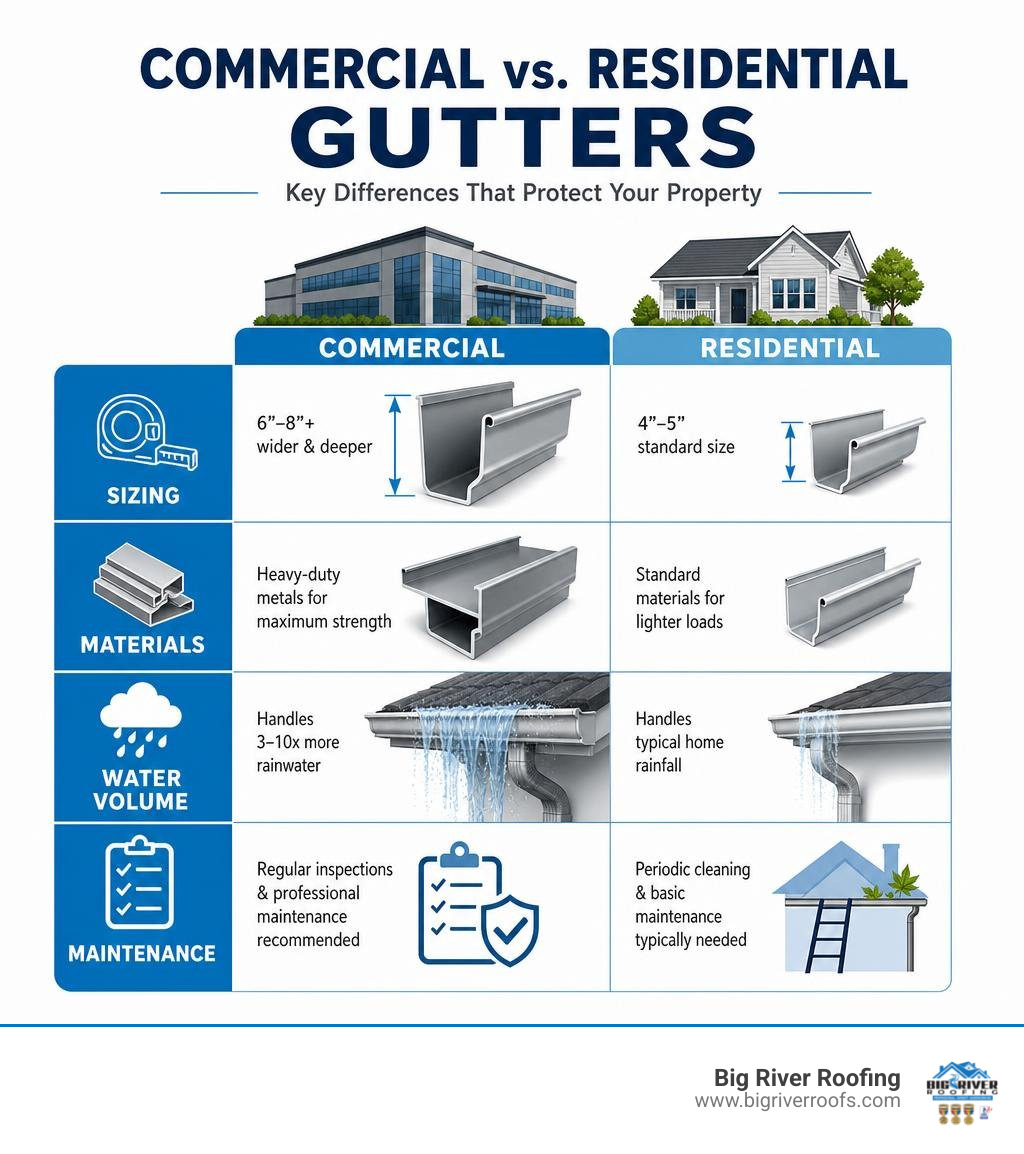
To understand why residential gutters fail on commercial buildings, we have to look at the sheer scale of commercial properties. A typical retail plaza, warehouse, or apartment complex in Western Pennsylvania handles vastly more roof square footage than a standard single-family home. Because of this massive surface area, commercial roofs shed 3 to 10 times more water during our heavy summer rainstorms and winter snowmelts.
This massive volume of water puts immense stress on the entire drainage system. If you try to cut corners by installing residential-grade gutters, you will quickly face overflowing water, rotted fascia boards, and compromised foundations.
Commercial systems are engineered differently from the ground up:
- Hanger Spacing: While residential gutters might have hangers spaced 24 to 36 inches apart, commercial standards require much tighter spacing — typically 18 to 24 inches on center. This extra support is critical for handling heavy snow and ice loads during Western PA winters.
- Material Thickness: Commercial-grade aluminum runs between 0.040 and 0.050 inches thick, compared to the thinner 0.027 or 0.032 inches used on residential homes.
- Thermal Expansion: All metal gutters expand and contract with shifting temperatures. Because commercial runs are often much longer, our installers must carefully calculate this movement to prevent buckling, warped metal, or cracked sealants.
Understanding these technical differences is why we always recommend reading about Why Seamless Gutters Are Worth Every Penny to see how continuous, custom-fabricated runs eliminate the weak seam points that fail under heavy commercial pressure.
| Specification | Residential Gutters | Commercial Gutters |
|---|---|---|
| Standard Sizing | 5-inch or 6-inch | 6-inch, 7-inch, or 8-inch+ |
| Material Thickness | 0.027″ – 0.032″ (Aluminum) | 0.040″ – 0.050″ (Aluminum) or 24-gauge Steel |
| Hanger Spacing | 24″ to 36″ apart | 18″ to 24″ apart (on center) |
| Common Profiles | K-Style, Half-Round | Box Gutter, Heavy-Duty K-Style |
| Downspout Sizes | 2″x3″ or 3″x4″ | 4″x5″ or 5″x6″ (Oversized) |
Sizing and Engineering for High Water Volume
Sizing commercial gutters isn’t a guessing game; it is a matter of precise physics and local meteorological data. When engineering a commercial drainage system in Western Pennsylvania, we calculate the roof’s watershed area alongside the region’s historical rainfall intensity.
While a 6-inch seamless gutter is the absolute minimum for light commercial use, larger roofs, complex parapets, or sloped metal structures often require 7-inch box gutters or even heavy-duty 8-inch profiles.
Equally important is matching the gutters to oversized downspouts. A massive gutter is useless if the downspouts choke on the water volume. Standard commercial downspouts are typically 4×5 inches or 5×6 inches, allowing them to rapidly evacuate water and prevent dangerous backlogs. For a deeper look into these calculations, check out Don’t Let It Overflow A Guide to Downspouts Per Foot of Gutter.
Commercial Gutter Profiles: Box, K-Style, and Half-Round
The shape of your gutter dictates both how much water it can hold and how it complements your building’s architecture:
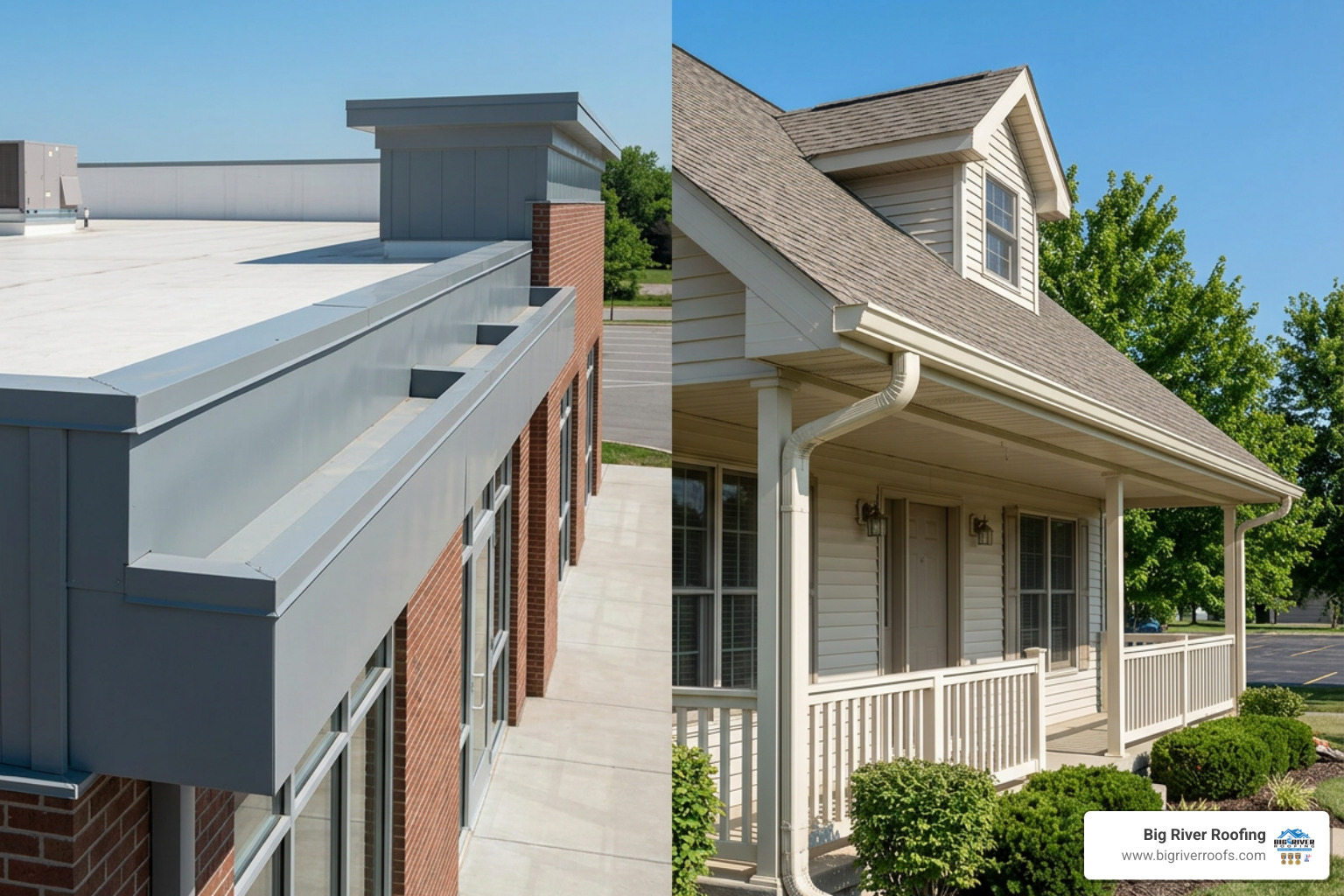
- Box Gutters: This is the most common profile for commercial and industrial structures. With their rectangular shape, box gutters maximize water capacity and are often tucked under the roofline or built directly into the roof’s edge. They are highly efficient for flat roofs or sloped metal warehouse roofs.
- K-Style Seamless: While popular in residential neighborhoods, heavy-duty K-style gutters in 6-inch or 7-inch sizes are excellent for offices, retail storefronts, and churches. They mimic the look of crown molding while providing high structural strength.
- Half-Round Gutters: These are semi-circular troughs that offer a smooth, classic look. They are typically specified for historic commercial buildings, municipal properties, or structures where maintaining architectural heritage is a priority.
Heavy-Duty Materials: Aluminum, Steel, and Copper
Selecting the right material balances durability, maintenance requirements, and upfront cost:
- Heavy-Duty Aluminum (0.040 to 0.050 inches): The industry favorite. It is lightweight, completely rust-proof, and can be custom roll-formed directly on the job site.
- 24-Gauge Galvanized Steel: Structurally much stronger than aluminum, steel can handle massive snow loads and resists denting. It also expands and contracts less during our extreme 100-degree temperature swings between summer and winter. However, it is heavier, harder to install, and must be treated to prevent rust.
- Copper: The premium choice. It develops a beautiful green patina over time, never rusts, and can easily last 50 years or more. It is highly durable but comes with a premium price tag. If you are considering this investment, read our breakdown on Classy But Costly What to Expect When Installing Copper Gutters.
For local sourcing, commercial operations in the region often rely on specialized local suppliers like Wholesale Gutter Supplies & Machines in Butler, PA or Gutter Supplies Near Pittsburgh to secure high-grade, commercial-spec metals and roll-forming equipment.
Signs of Gutter Failure: Repair vs. Replacement
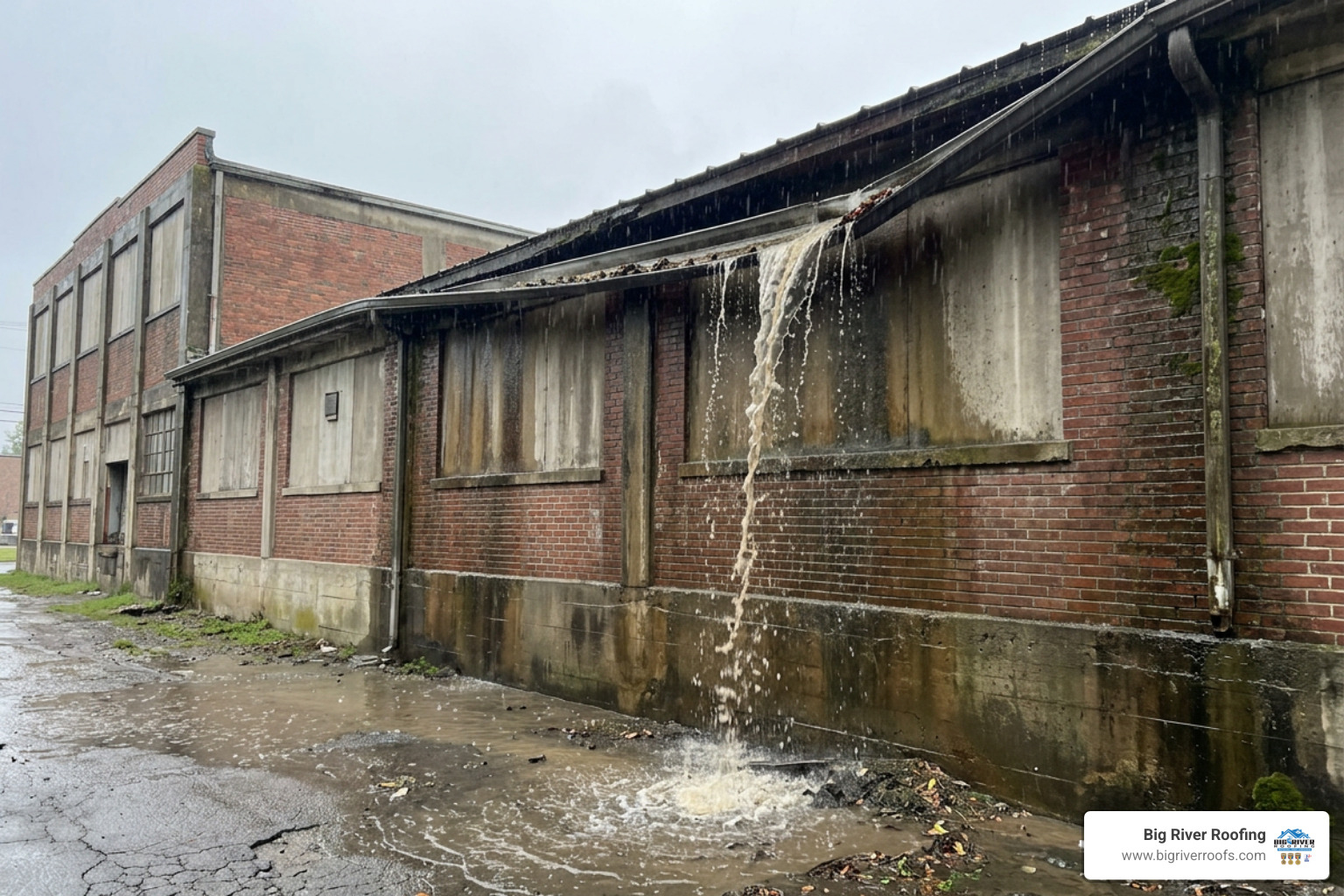
Commercial gutter failure rarely stays localized. Because of the sheer volume of water involved, a failing system can quickly damage other parts of your property. If water overflows the gutter edge, it runs directly down your building’s exterior walls, causing stucco staining, brick mortar erosion, and mold growth. Even worse, water pooling at the base of your building can saturate the soil, causing foundation shifting, basement flooding, and costly landscaping washouts.
Common Signs of Commercial Gutter Failure
Keep an eye out for these warning signs during your monthly property walks:
- Standing Water: If you spot water sitting in your gutters days after a storm, the system is either severely clogged or has lost its proper pitch. Standing water adds immense weight, which leads to sagging.
- Peeling Seams and Rusted Miters: Traditional sectional gutters eventually leak at the joints. If you see rust stains or mineral deposits dripping from the corners, the sealant has failed.
- Fascia and Wood Rot: When water backs up behind the gutter, it rots the wood fascia board it is mounted to. Once the fascia rots, the gutter hangers lose their grip, causing the system to pull away from the building.
- Landscape and Soil Erosion: Deep trenches carved into the mulch or soil directly beneath your roofline indicate that water is bypassing your gutters entirely.
To understand how individual components like downspout elbows can fail and cause backups, read our Downspout Elbows and Connectors A Complete Guide. If you notice these symptoms in Mercer County, you can also look into professional Gutter Repair Services in Hermitage, PA to address localized issues before they spread.
When to Repair vs. Full Replacement
How do you know when it is time to patch a leak versus tearing the whole system down?
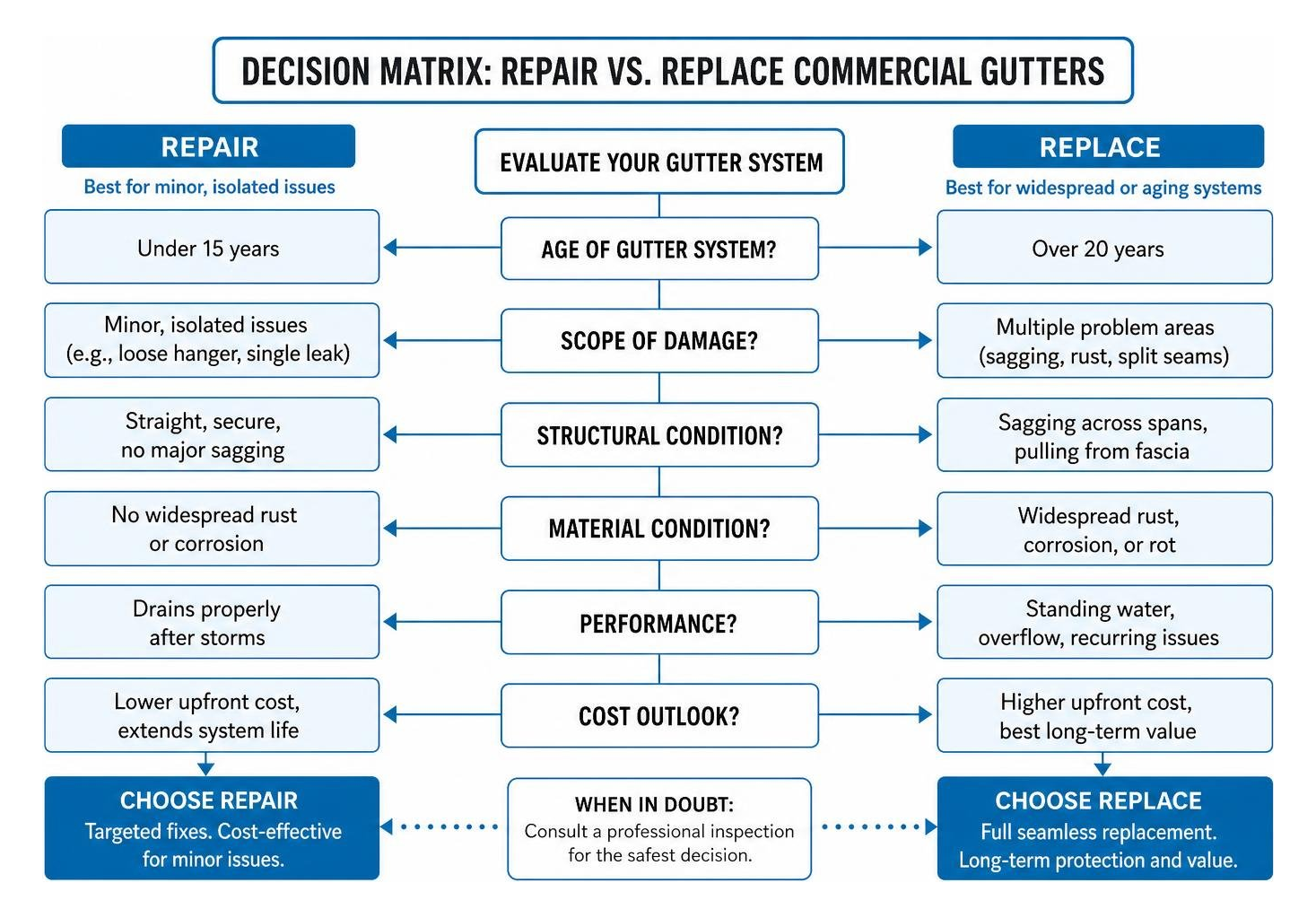
If your commercial gutters are under 15 years old and only experiencing minor, isolated issues — like a loose hanger or a single leaking seam — a targeted repair is highly cost-effective. However, if your gutters are over 20 years old, sagging across multiple spans, or showing widespread rust and split seams, continuous patching is simply throwing good money after bad.
At this stage, a full seamless replacement is the most cost-effective long-term solution. To help plan your budget, consult our guide on Don’t Get Drained Average Cost of Gutters Per Linear Foot.
How to Choose the Best Commercial Gutter Companies Near Me
Commercial gutter installation requires specialized equipment, heavy-duty safety training, and a deep understanding of structural engineering. You should never hire a standard residential “handyman” to handle a commercial-scale project.
What to Look For in Commercial Gutter Companies Near Me
When researching commercial gutter companies near me, make sure to verify these critical credentials:
- Licensing and Insurance: Never work with a contractor who cannot immediately provide up-to-date Certificates of Insurance (COIs) showing both general liability and worker’s compensation. Commercial roofs are high-risk environments, and you must protect your business from liability.
- In-House Labor: Ask if the company uses their own trained employees or if they subcontract the work out. In-house crews ensure consistent quality control and accountability.
- Business Longevity: With nearly 96% of roofing and exterior contractors failing within their first five years, look for companies with a proven local track record.
- Transparent, Written Estimates: A reputable contractor will provide a detailed, line-item estimate outlining materials, labor, permits, and warranties.
For larger properties near Allegheny County, studying established regional standards like Gutters & Downspouts Installation & Cleaning in Pittsburgh can give you an idea of the professionalism and scale required for commercial projects.
Navigating Building Codes and Stormwater Regulations
Commercial properties in Western Pennsylvania must comply with strict municipal building codes and environmental regulations. Depending on your township or county, you may be prohibited from simply letting your downspouts discharge onto the pavement or into neighboring properties.
Many local codes require commercial properties to integrate their downspouts directly into underground storm sewer systems, retention ponds, or dedicated drainage basins. Experienced commercial gutter companies near me will understand these local regulations and ensure your system is fully compliant, utilizing heavy-duty Schedule 40 PVC underground piping rather than cheap, easily crushed corrugated plastic.
Commercial Gutter Maintenance and Protection
Installing a premium commercial gutter system is only half the battle. Without regular maintenance, even the best-engineered systems will eventually fail.
Why You Need Commercial Gutter Companies Near Me for Maintenance
Maintaining commercial gutters is a dangerous and highly specialized task. Multi-story office buildings, retail centers, and industrial facilities require OSHA-compliant safety harnesses, lifts, and high-reach ladders.
Furthermore, professional crews don’t just scoop out leaves; they utilize high-powered gutter vacuums, perform controlled water flow tests to check the system’s pitch, inspect the structural integrity of the fascia boards, and clear out underground drainage lines.
If your property is in Beaver County, scheduling regular service with a specialized provider like Get Commercial Gutter Cleaning in Beaver County, PA is an excellent way to keep your system flowing freely year-round.
Gutter Guards and Leaf Protection for Commercial Properties
For commercial properties surrounded by mature trees, manual cleaning several times a year gets incredibly expensive. Installing heavy-duty, commercial-grade gutter guards is a smart investment that can pay for itself in just a few seasons by dramatically reducing maintenance costs.
We highly recommend micro-mesh gutter guards. These systems feature a stainless steel mesh that blocks even the smallest debris — like pine needles and maple seeds — while allowing heavy rainwater to flow through freely. To learn more about selecting the right protection, read The Ultimate Guide to Gutter Guards and explore our top recommendations in Stop the Clog With the Best Micro Mesh Gutter Guards.
Frequently Asked Questions About Commercial Gutters
How often should commercial gutters be cleaned?
As a general rule, commercial gutters should be cleaned and inspected at least twice a year — once in the spring and once in late autumn after the leaves have fallen. However, if your property is located near dense foliage, pine trees, or in a high-wind area, you may need to schedule cleanings three or four times a year to prevent major blockages.
What is the standard size for commercial gutters?
While residential homes typically use 5-inch gutters, the standard minimum size for commercial properties is 6-inch seamless aluminum. For larger roofs, complexes with steep pitches, or industrial facilities, 7-inch or 8-inch box gutters are standard to safely handle high water volumes.
Can you install gutter guards on commercial buildings?
Absolutely. Installing commercial-grade micro-mesh gutter guards is one of the most effective ways to lower your ongoing property maintenance expenses. They prevent clogs, eliminate standing water that attracts pests, and protect your building’s foundation from overflow damage.
Conclusion
Your commercial building is a massive investment, and keeping its roof and drainage system in peak condition is vital to protecting its structural integrity and long-term value. From calculating rainfall intensity and on-site seamless fabrication to navigating local stormwater regulations, managing commercial water runoff requires specialized expertise.
At Big River Roofing, we specialize in providing Western Pennsylvania businesses with high-quality, manufacturer-certified roofing and gutter solutions. Whether your property is in Hermitage, Mercer, Lawrence, Butler, or Beaver County, our team is here to deliver honest communication, top-tier craftsmanship, and dependable protection.
If you suspect your commercial drainage system is failing, don’t wait for the next heavy storm to cause costly interior water damage. Visit our dedicated Gutters service page today to learn more, or contact us directly to schedule your free, professional inspection.