
Why Your Gutter Spout Guard Could Be the Cheapest Home Repair You Ever Make
A gutter spout guard is a simple device that sits at the top of your downspout opening to block leaves, twigs, and debris from getting inside — while still letting water flow through freely.
Quick answer: Are gutter spout guards worth it?
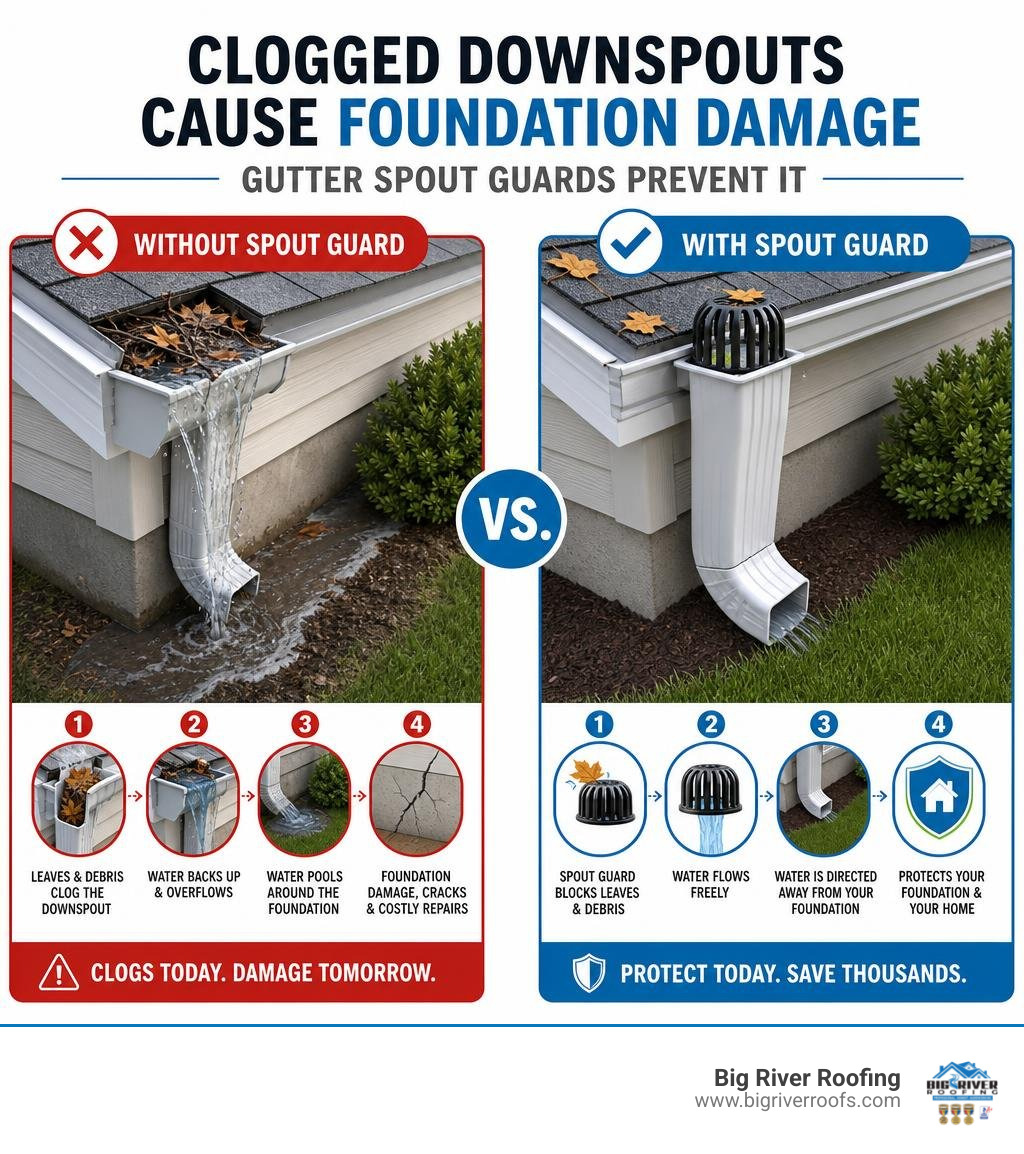
- Yes, for most homeowners. They prevent costly downspout clogs that can cause water to back up, overflow, and damage your foundation.
- They cost very little (often under $20 for a pack) and most require zero tools to install.
- They work best as part of a broader gutter maintenance routine — not a complete replacement for cleaning.
- Homes surrounded by mature trees or with buried drain pipes benefit the most.
Here’s the thing: most homeowners don’t think about their gutters until water is pouring down the side of their house. By then, the damage is already happening. Clogged downspouts are one of the most common — and most overlooked — causes of foundation problems, basement moisture, and landscape erosion.
The good news? A small, inexpensive guard at the top of each downspout can stop the problem before it starts.
I’m Don Kovac, owner of Big River Roofing in Hermitage, Pennsylvania, and over the years I’ve seen how a neglected gutter spout guard — or the absence of one — can turn a $15 fix into a $5,000 foundation repair. Let’s walk through everything you need to know to protect your home the right way.
Gutter spout guard terms simplified:
What is a Gutter Spout Guard and How Does It Work?
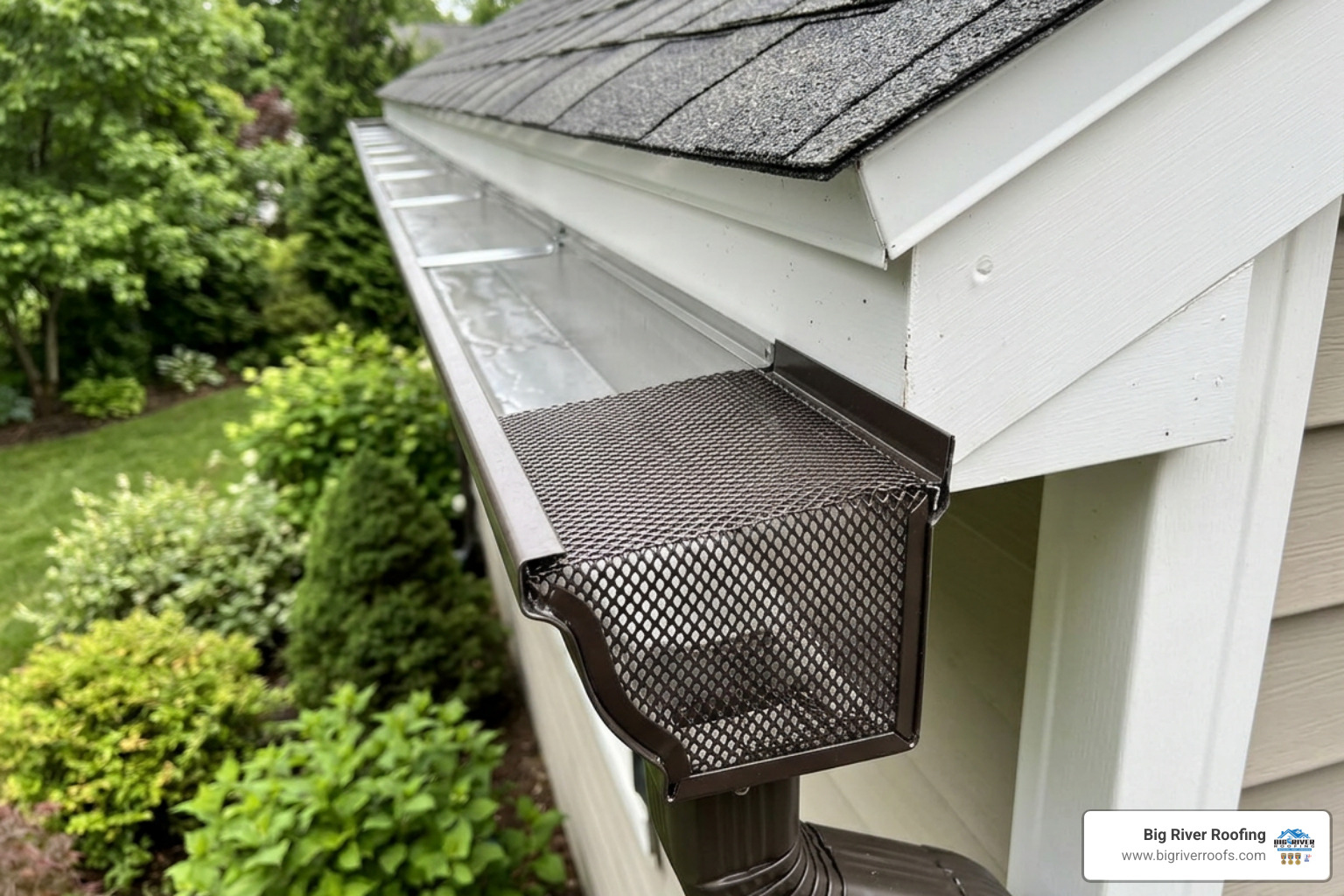
At its core, a gutter spout guard (often called a downspout strainer, balloon guard, or downspout filter) is a simple physical barrier placed directly over or inside the drop outlet of your gutter. This outlet is the transition point where the horizontal gutter run meets the vertical downspout.
Without a guard, this opening acts like a giant funnel, swallowing up everything the wind blows onto your roof. A guard works by filtering out bulky debris while allowing rainwater to pass through the gaps and escape down the spout.
When managing heavy water flow, especially at high-impact roof valleys, homeowners often pair these spout guards with specialized redirecting tools. For instance, a quality Unstoppable Valley Gutter Splash Guard | Inside Corner | White can prevent high-velocity water from overshooting your gutter system entirely, keeping the water contained so it can travel safely toward your protected downspout.
Why Downspouts Clog
To understand why a gutter spout guard is so vital, we have to look at what actually goes on inside your Gutters.
Gutters are open channels designed to collect water. However, they also collect:
- Deciduous leaves and pine needles: The absolute classic culprits.
- Twigs and branches: Dropped by overhanging trees during Western Pennsylvania storms.
- Roof grit: Tiny asphalt shingle granules that wash off over time and form a heavy, sludgy paste at the bottom of the channel.
- Organic muck: Dust, pollen, bird droppings, and decomposing organic matter that creates a fertile ground for weeds to actually sprout in your gutters.
When these items wash toward the downspout, they hit the elbows—the sharp, angled bends in your downspout pipe. Because these elbows have a reduced slope and restricted space, debris easily wedges itself inside. Once a single twig gets stuck, it acts as a dam, catching leaves and roof grit until the entire pipe is packed solid. The result? Standing water that cannot drain, leading to heavy, sagging gutters and eventual wood rot along your roofline.
The Mechanics of a Gutter Spout Guard
So, how does a downspout guard stop this? It relies on simple but highly effective physics.
Most guards use a friction fit or a drop-in design. By sitting slightly elevated above the gutter floor, they create a raised physical barrier.
As water carries debris down the horizontal run of the gutter, the bulky leaves and twigs hit the outer walls of the guard and stop. Meanwhile, because the guard is porous (featuring wire mesh, slots, or brush bristles), the water continues to flow through the open spaces, dropping straight down into the downspout.
By keeping the debris outside of the downspout, the guard ensures that any buildup remains in the wide, open horizontal gutter channel where it is incredibly easy to see and clean out, rather than packed tightly inside a narrow, hidden downspout elbow.
Types and Materials of Downspout Guards

When you start shopping for a gutter spout guard, you will quickly realize there is no shortage of options. In fact, there are over 1,000 results for “Gutter Downspout Guards” on Amazon alone. To make sense of it all, we can break them down by their primary materials and designs.
- Galvanized Steel and Aluminum: These are the heavy-duty workhorses of the gutter world. Metal guards resist rust, stand up to heavy snow loads, and won’t warp or crack under the intense summer sun. They are highly favored by professional contractors for their longevity.
- Plastic and Vinyl: These are the most budget-friendly options. While they are incredibly easy to install and won’t rust, they are susceptible to becoming brittle and cracking after a few years of exposure to UV rays and freezing Pennsylvania winters.
- UV-Protected Nylon and Specialty Cylindrical Brushes: Products like the Gutter Downspout Guards – 4 Pack – GutterBrush Gutter Guards offer a completely different approach. Instead of a hard cage, they use dense, heavy-duty bristles wrapped around a wire core. Water flows through the bristles while leaves are kept elevated on top.
Wire Strainers vs. Brush Guards
The two most popular DIY downspout protection designs are wire strainers (often expandable diamond mesh) and cylindrical brush guards. Both have their unique advantages, but they handle debris quite differently.
| Feature | Wire Mesh Strainers | Cylindrical Brush Guards |
|---|---|---|
| Material | Galvanized steel, aluminum, or copper | UV-protected polypropylene bristles on wire core |
| Installation | Compressed and inserted into the drop outlet | Slid directly into the gutter channel over the outlet |
| How It Works | Blocks debris at the immediate entry point of the spout | Fills the local gutter area to keep debris elevated |
| Debris Capacity | Low to moderate (can clog quickly if neglected) | High (large surface area keeps water flowing longer) |
| Lifespan | 10 to 20+ years (for quality metal) | 10+ years (often backed by solid warranties) |
| Best For | Heavy rain and budget-friendly protection | Wooded areas with heavy leaf drop and pine needles |
Wire strainers are highly efficient at blocking large leaves, but because of their relatively small surface area, a handful of wet leaves can completely cap them, requiring you to climb up and clear them off fairly often.
Brush guards, on the other hand, offer a much larger surface area. Even if some leaves get caught in the top bristles, water can still find its way through the lower sections of the brush and drain successfully.
Choosing the Right Gutter Spout Guard Size
Getting the right fit is crucial. If a guard is too small, debris will slip right past the edges; if it is too large, it won’t sit flush, creating gaps.
To choose the right size, you need to understand your gutter and downspout dimensions:
- Measure your gutters: Standard residential gutters are typically 5 inches wide, while oversized residential or commercial gutters are 6 inches wide.
- Measure your downspout openings: Most residential downspouts are either 2×3 inches or 3×4 inches (rectangular), or 3 inches (round).
- Choose the matching guard:
- For standard wire strainers, look for expandable designs that can be compressed to fit both 2×3 and 3-inch round openings.
- For brush-style guards, a 4.25-inch diameter brush is perfect for standard 5-inch gutters, while a 5.25-inch diameter brush is required for 6-inch gutters.
Always measure across the top of your gutter from the back to the front lip before ordering to ensure a seamless fit.
Gutter Spout Guards vs. Full Gutter Protection Systems
It is common to wonder: Why should I just buy a downspout guard when I could cover my entire gutter system?
This is a classic comparison of localized protection versus complete protection. Let’s look at how they stack up in terms of cost, performance, and maintenance.
A gutter spout guard is a localized solution. It only protects the downspout opening. The rest of your horizontal gutter run will still collect leaves, twigs, and debris. This means you will still need to clean your gutters regularly, but the cleaning process will be much easier because you won’t have to deal with packed, impacted clogs inside the downspout pipes.
A full system, such as high-quality gutter guards or gutter guards micro mesh, covers the entire length of your gutters. These systems block debris from entering the gutter channel in the first place, meaning you rarely, if ever, have to clean them out.
If you are trying to decide which route to take, consider the financial investment. When looking at the average cost of leaf guards, a full-coverage system installed across your entire home is a larger upfront investment, though it offers ultimate peace of mind. By contrast, a downspout guard is incredibly cheap—often costing less than $20 to $50 for the entire house.
For some homeowners, especially those pairing guards with newly installed, highly efficient seamless gutters, a full-coverage micro-mesh system is the best long-term choice to eliminate maintenance. But if you are on a budget or don’t mind doing light seasonal scooping, simple downspout guards are an exceptionally cost-effective way to prevent catastrophic water damage.
Installation and Maintenance: What Homeowners Need to Know
One of the greatest selling points of a gutter spout guard is how incredibly easy it is to install. Most metal wire strainers and brush guards feature a tool-free, drop-in design.
Here is a quick step-by-step guide to installing a standard expandable wire mesh strainer:
- Safety First: Set up a sturdy extension ladder on flat ground. Always have a spotter when working at heights.
- Clean the Area: Before putting the guard in, thoroughly clean out any existing debris, mud, or shingle grit from the gutter and the downspout opening.
- Compress and Insert: Wear protective gloves (mesh edges can be sharp!). Squeeze the bottom of the wire strainer slightly to compress it.
- Set the Fit: Push the compressed end down into the downspout opening. Release it, allowing the expandable metal to spring outward and create a snug friction fit against the walls of the drop outlet.
- Test Water Flow: Pour a bucket of water (or run a garden hose) into the gutter to ensure water drains rapidly through the guard.
While these residential guards are simple, larger drainage systems sometimes require heavy-duty commercial solutions. For example, in municipal or construction applications, products like the Ultra-Gutter Guard® – SpillContainment.com are used to filter massive amounts of sediment and debris out of roadside curb inlets. The principle is the exact same: keep the debris out of the pipes so the water can flow freely.
The Reality of Maintenance
Let’s bust a common myth: no gutter protection system is completely maintenance-free.
Because a downspout guard stops debris right at the entrance of the pipe, leaves will accumulate around the base of the guard over time. If you live in an area with heavy tree cover, you will need to inspect and clean your guards at least twice a year—typically in the late spring and late fall.
Fortunately, cleaning them is a breeze. Instead of having to take your downspouts apart or use a plumbing snake to clear out a deep clog, you simply reach into the gutter, scoop away the loose leaves resting against the guard, and you’re done!
Frequently Asked Questions about Downspout Protection
Do downspout guards restrict water flow during heavy rain?
Under normal conditions, high-quality downspout guards do not restrict water flow. The open diamond mesh of wire strainers and the porous design of brush guards are engineered to handle high volumes of water. However, if a guard is neglected and becomes completely covered in a thick layer of wet leaves, it can act as a plug.
To prevent water from overshooting your gutters in high-impact areas, you can install heavy-duty Rain Gutter Valley Splash Guards along your roof valleys to keep water channeled where it belongs.
How often do downspout strainers need to be cleaned?
As a general rule, plan to check your strainers twice a year. If your home is surrounded by heavy pine trees (which shed needles year-round) or mature oaks, you may want to check them every few months during the autumn season. The task takes only a few minutes but saves hours of head-scratching later.
Can I install downspout guards myself without tools?
Absolutely. Most popular downspout guards—including expandable aluminum mesh baskets and brush guards—require absolutely no screws, drills, or specialized tools. They rely entirely on a friction fit. You simply compress them, drop them into place, and let them expand.
If you prefer professional-grade retail systems that cover the entire gutter, you will often find options like Gutter Guard by Gutterglove | Home Depot’s Exclusive Gutter Guard , which offer straightforward DIY installation kits with clear instructions.
Conclusion
At the end of the day, a gutter spout guard is one of the smartest, most cost-effective preventative measures you can take to protect your home. For a tiny investment of time and money, you can safeguard your foundation, keep your basement dry, and prevent your gutters from pulling away from your roofline.
If you are looking to upgrade your home’s exterior, whether you need a complete gutter overhaul, seamless installations, or professional advice on the best protection for your roof, our team at Big River Roofing is here to help. We proudly serve homeowners across Western Pennsylvania, including Hermitage, Mercer County, Lawrence County, Butler County, Beaver County, and Allegheny County.
Ready to put an end to gutter stress? Contact us today to schedule a free inspection and explore our professional Gutters and roofing services!