Quick answer
Most winter roof leaks in western Pennsylvania come from snow, ice dams and attic frost, not rain. Melting snow backs up under shingles at the cold roof edge, and frost in the attic drips when it thaws. If you see stains or drips in Mercer, Lawrence, Butler or Beaver counties, book a free roof inspection.
Most winter roof leaks don’t come from rain. They come from snow, ice and the warm, damp air inside your house. Snow sits on the roof for days, melts a little each afternoon and refreezes each night. That water ends up in places a roof isn’t built to handle, like under the shingles at the eaves or around a chimney. Meanwhile, moisture from showers, cooking and breathing rises into a cold attic, freezes on the underside of the roof and drips when it thaws. In western Pennsylvania, where winters swing above and below freezing week after week, these are some of the most common winter calls we get from homeowners in Mercer, Lawrence, Butler and Beaver counties.
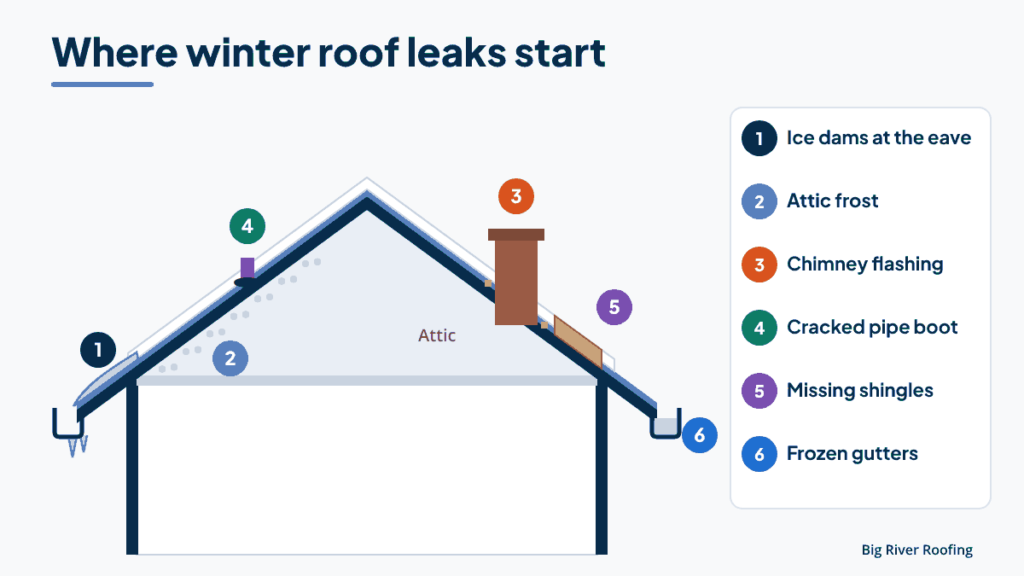
Here are the six most common reasons a roof leaks in winter, how to tell them apart, and what to do about each one.
1. Ice dams at the roof edge
An ice dam is a ridge of ice along the eaves. Heat escaping into the attic melts the snow higher up the roof, the water runs down, and it freezes again at the cold edge. More meltwater then pools behind the ice and backs up under the shingles. These leaks usually show up along outside walls and near the corners of upstairs ceilings, and they often start after a few days of snow followed by sunny afternoons.
Ice dams are the most common winter leak by far, so we wrote a full guide to ice dams in western PA: how they form, what to do safely when you see one, and how to stop them.
2. Attic condensation and frost (the “leak” that isn’t the roof)
Sometimes the roof is fine and the water comes from inside the house. Warm, moist air leaks into the attic through gaps around lights, bath fans and the attic hatch. When it hits the cold roof deck, it freezes into a layer of frost on the wood and nail tips. On the first mild day, all that frost melts at once and drips onto the insulation and ceiling. It can look exactly like a roof leak.
Clues that it’s condensation rather than a hole in the roof:
- The water shows up on a mild or sunny day, not during a storm.
- You see frost, or rows of water drops on the nails, across a wide part of the attic instead of one spot.
- The insulation is damp in many places, not just under one point.
- Bath fans that vent into the attic, instead of outside, make it worse.
The fix is the same as for ice dams: seal the air leaks into the attic and keep air moving through it. ENERGY STAR explains that air sealing and insulation keep the attic cold in winter by blocking heat and moist air from below, and that attic ventilation helps keep it cold. Big River installs roof ventilation and ridge vents, and our free roof inspection includes a look at the attic airflow.
3. Flashing that has pulled away
Flashing is the metal that seals the joints where the roof meets a chimney, a wall, a skylight or a vent. Every freeze and thaw makes the roof, the flashing and the chimney move a little, and they don’t all move the same amount. Over a few winters, caulk cracks and flashing lifts. Melting snow then runs straight into the gap. A stain on the ceiling near a chimney, or around a skylight frame, is a strong sign the flashing is the problem. Our roof repair crew fixes chimney, skylight and wall flashing.
4. Cracked pipe boots
Plumbing vent pipes come through the roof with a rubber collar, called a pipe boot, sealed around them. Sun and cold wear that rubber out, and a boot that looked fine in the summer can split in January. Because snow piles up around vent pipes and melts slowly, a cracked boot can let in a steady drip for days. The leak usually shows up over a bathroom or along an inside wall.
5. Wind-damaged or missing shingles
Winter storms bring strong wind, and a shingle that was lifted or loosened in the fall can tear off in the first big blow of the season. Snow then melts straight onto the exposed spot. If you notice shingle pieces in the yard or a dark patch on the roof after a storm, have it checked before the next snowfall. Our missing shingle replacement page explains what we look at when one or two shingles are gone, and our storm damage roofing page covers bigger storm repairs.
6. Frozen or clogged gutters
Gutters full of leaves hold water, and in a cold snap that water freezes solid. Meltwater from the roof then has nowhere to go. It can spill behind the gutter, soak the fascia board and work its way into the wall or the roof edge. Clean gutters in late fall, after the leaves come down, and check that the downspouts are clear.
How to tell where the water is coming from
Water travels. It can run along a rafter or the top of the drywall for several feet before it drips, so the stain is often not right under the problem. A few quick checks help narrow it down:
- When does it drip? During a storm points to the roof itself. On a mild, sunny day after cold weather points to ice dams or attic frost.
- Where is the stain? Along an outside wall suggests ice dams. Near a chimney, skylight or bathroom points to flashing or a pipe boot.
- What does the attic look like? With a flashlight, look for frost, wet insulation or dark streaks on the wood. Stay on the joists and don’t step between them.
If you can’t find the source, our roof leak detection service traces the water back to where it actually gets in, then fixes that spot.
What to do when your roof leaks in winter
- Stay off the roof. A roof with snow or ice on it is extremely slippery, and ladders slide on frozen ground.
- Catch the water. Put down buckets and towels, and move furniture, rugs and electronics out of the way. If water is near a light fixture or outlet, turn that circuit off at the breaker.
- Relieve a bulging ceiling. If water is pooling in a ceiling bubble away from any light fixture, a small hole at the lowest point with a bucket underneath lets it drain in one place instead of bringing down the drywall.
- Take dated photos of the stain, the drip and anything wet in the attic. They help with the repair and with any insurance claim.
- Call a roofer. Big River Roofing gives active leaks priority. In some cases we can install an emergency tarp the same day to stop the water until a permanent repair is scheduled. Call (724) 877-7380.
Winter weather can change fast here. The National Weather Service office in Pittsburgh covers Mercer, Lawrence, Butler and Beaver counties and is the best place to check for the next thaw or hard freeze.
Can a roof be repaired in winter?
Yes. Leaks, flashing, pipe boots and missing shingles can all be fixed in the winter, and waiting until spring usually means more damage inside. Some work goes best on a dry day above freezing, so a repair may be done in two steps: stop the water now, then finish the permanent fix on the next good weather window. If an inspection shows the roof is near the end of its life, we’ll tell you honestly whether a repair or a full roof replacement makes more sense.
Frequently asked questions about winter roof leaks
Why is my roof leaking when it isn’t raining?
In winter, the most common reasons are melting snow backing up behind an ice dam, and frost in the attic melting on a mild day. Both happen without any rain. If the drip starts a day or two after snow, on a sunny afternoon, one of these two is the likely cause.
Is a winter roof leak an emergency?
If water is coming through a ceiling or light fixture, treat it as urgent and call the same day. Water in the ceiling can soak insulation, stain drywall and reach wiring. A small stain that isn’t growing can usually wait for a scheduled inspection, but don’t leave it until spring.
Does homeowners insurance cover winter roof leaks in Pennsylvania?
It depends on your policy and on the cause. Sudden damage, like a storm tearing off shingles, is often treated differently from wear or slow leaks. The Pennsylvania Insurance Department’s homeowners guide explains that dwelling coverage pays for damage to your house, and it says to talk to your agent or insurance company about what your policy covers. When the damage is covered, Big River offers insurance claims assistance from the first inspection to the final repair.
How do I stop condensation in my attic?
Seal the gaps that let warm, moist air into the attic, make sure bath and kitchen fans vent outside, and keep the soffit vents clear so outside air can move through. A roofer can check whether the attic has enough ventilation for its size.
Will one winter leak damage the roof deck?
A single short leak usually won’t. Water that keeps coming back all winter can soften the plywood and cause mold. If the roof feels soft or a section sags, have it checked by our structural roof repair team.
Get a winter leak checked before it spreads
If you’re seeing stains, drips or frost in the attic this winter, a free roof inspection will show you where the water is coming from and what it will take to fix it. Big River Roofing serves Hermitage and homeowners across Mercer, Lawrence, Butler and Beaver counties from our office at 2404 E State St, Hermitage, PA 16148. Call (724) 877-7380 or request your free estimate online.