What to Do When a Storm Damages Your Roof
Storm damage roof replacement is one of the most stressful situations a homeowner can face — but knowing the right steps makes the process far less overwhelming.
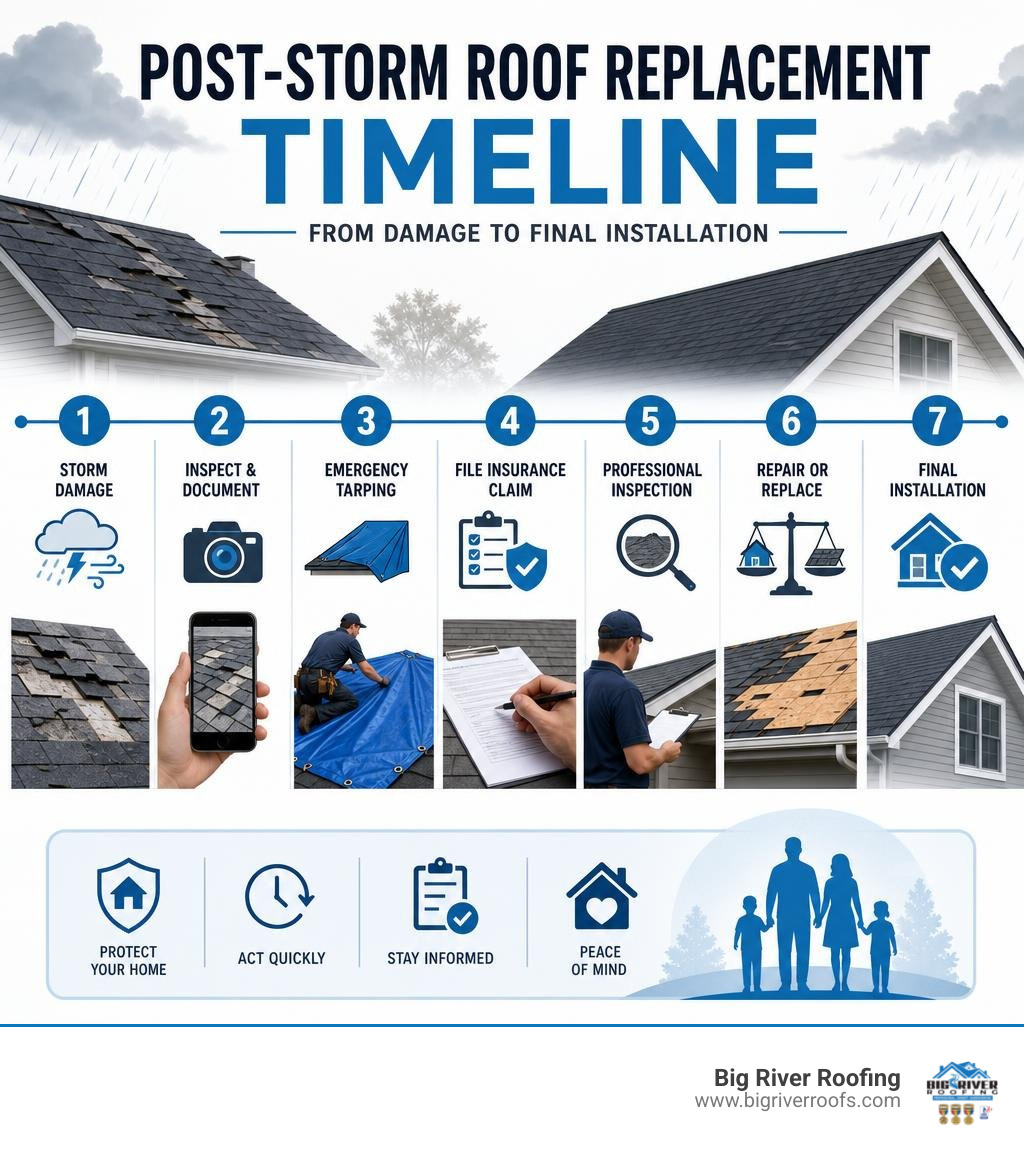
Here’s a quick answer if you’re in a hurry:
- Stay safe. Don’t climb on the roof. Inspect from the ground.
- Document everything. Take timestamped photos and videos of all visible damage before touching anything.
- Stop further damage. Call a local roofer to arrange emergency tarping within 24–48 hours if water is entering.
- File your insurance claim promptly. Contact your insurer, open a claim, and get a claim number.
- Get an independent inspection. Have a licensed local contractor assess the damage before accepting any settlement offer.
- Decide: repair or replace? Use the 25% building code rule and the 70% financial rule to guide the decision (explained below).
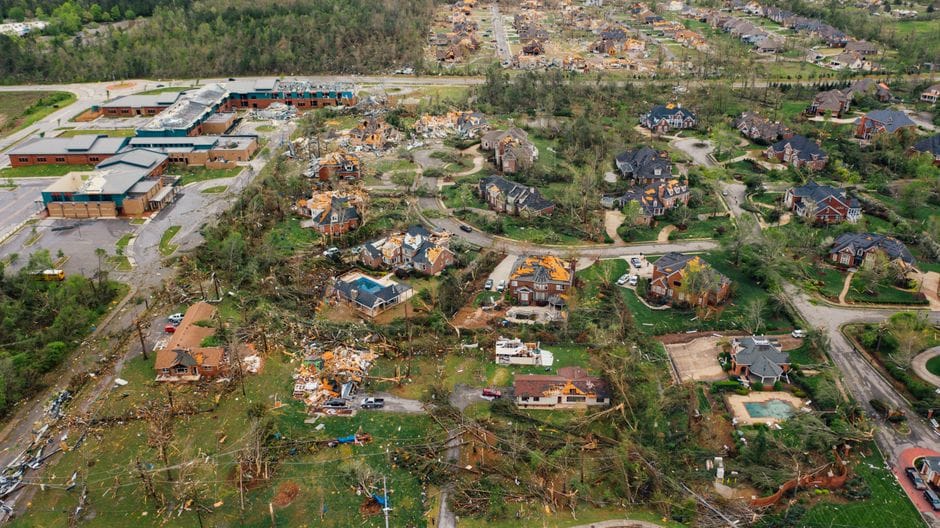
Western Pennsylvania storms — heavy hail, high winds, and late-season ice — can compromise a roof fast. What looks like a few missing shingles from the driveway can hide granule loss, bruised shingles, and compromised underlayment that leads to leaks, mold, and structural damage if left unaddressed.
The stakes are real. Unaddressed water damage can exceed $20,000 in structural repairs. And with hail damage accounting for roughly 40% of all weather-related insurance claims in the U.S., knowing how to respond quickly and correctly matters.
I’m Don Kovac, owner of Big River Roofing — a family-run roofing contractor based right here in Hermitage, PA. After years of helping Western Pennsylvania homeowners navigate storm damage roof replacement, from emergency tarping through final insurance settlement, I’ve put together this guide to walk you through every step of the process clearly and honestly.
Identifying Storm Damage: Wind, Hail, and Water Intrusion
When a severe storm rolls through Mercer, Lawrence, or Beaver County, the damage left behind isn’t always as obvious as a fallen oak tree splitting your rafters. Often, the damage is silent, microscopic, and progressive.
Understanding how different weather patterns affect your home is the first step in determining if you need a full replacement or a targeted Wind Damage Roof Repair.
Spotting Wind Damage and Lifted Shingles
High winds do not just blow shingles completely off your roof; they also create pressure differentials that lift shingles and break their adhesive seals.
Here is what wind damage actually looks like:
- Missing Shingles: The most obvious sign. When shingles are torn away, your underlayment and roof deck are directly exposed to rain.
- Broken Adhesive Seals: If wind lifts a shingle, it breaks the manufacturer’s tar sealant strip. Even if the shingle lays back down flat, the seal is broken. The next rainfall will push water under the shingle, leading to rot.
- Creased Shingles: High winds fold shingles backward, creating a dark, horizontal crease line near the top where the shingle bent. These creased shingles are structurally dead and will snap off during the next wind event.
- Exposed Underlayment or Decking: If you can see black felt paper or bare plywood from the ground, your roof is in an active state of failure.
Identifying Hail Damage and Bruised Shingles
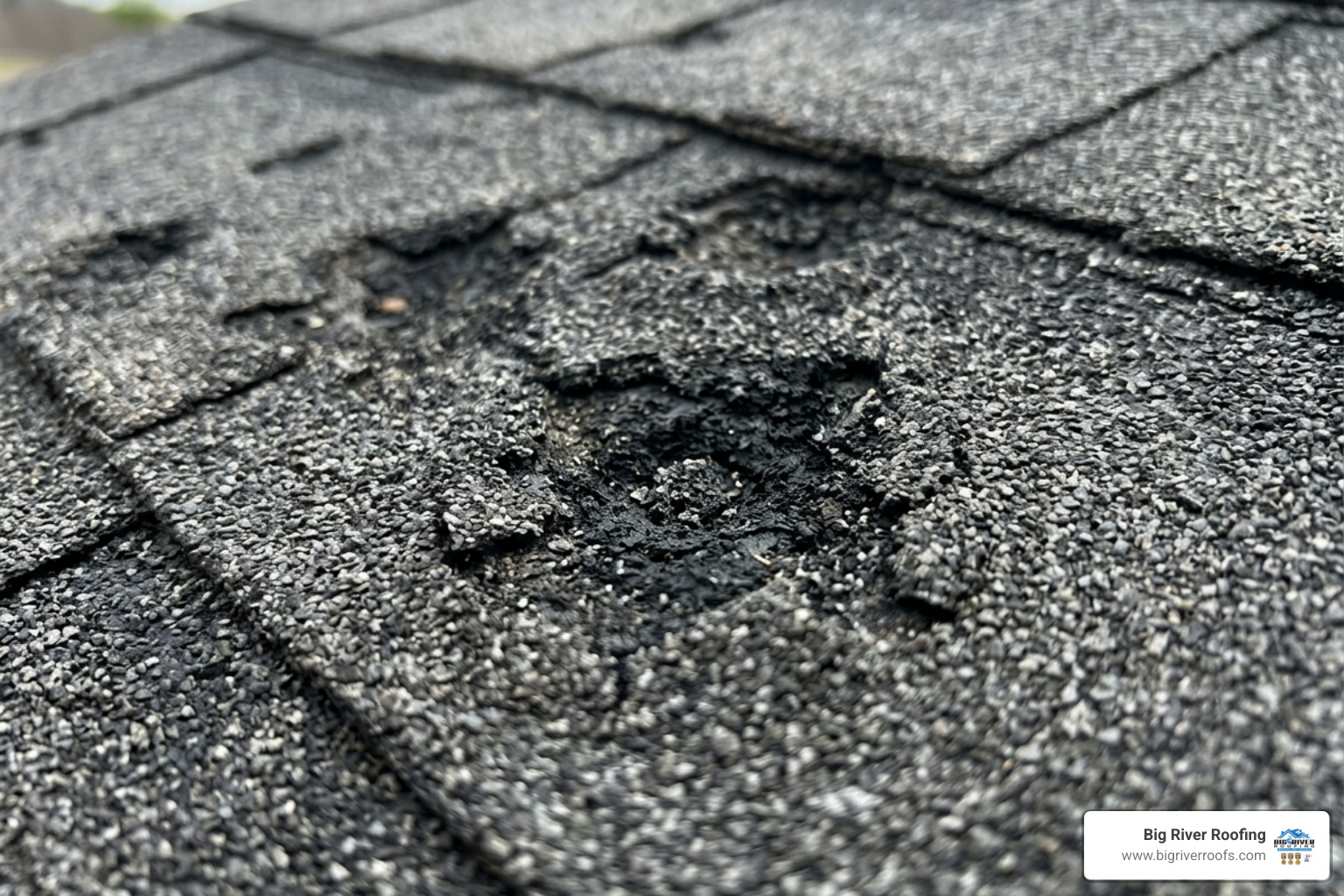
Hail damage is notoriously difficult for homeowners to identify because it rarely causes immediate leaks. Instead, hail acts like a hammer, bruising the shingle and knocking away the protective ceramic granules.
If you suspect hail has hit your home, look for these signs:
- Shingle Bruising: Hail leaves dark, circular impacts where the granules were smashed into the asphalt mat. Over time, UV rays degrade this exposed asphalt, making it brittle and prone to cracking.
- Granule Loss: Check your gutters and downspouts. If you see piles of sand-like granules after a storm, your shingles have lost their protective armor.
- Dented Gutters and Metal Accents: Soft metals like aluminum gutters, box vents, and flashing will show clear dings and dents. If your gutters are dented, your shingles almost certainly took a beating too.
If you are dealing with localized impact, you might only need a Hail Damage Roof Repair to restore your home’s envelope. However, widespread bruising across multiple slopes usually points to a full replacement.
Repair vs. Replacement: The 25% and 70% Rules
Determining whether to patch a few slopes or invest in a full storm damage roof replacement is not a guessing game. It is driven by local building codes, financial math, and the physical age of your roof.

If your roof is already approaching the end of its natural lifespan, pouring money into partial repairs is often a waste of resources. A simple Roof Repair might keep water out temporarily, but it won’t fix systemic storm damage.
The 25% Building Code Rule for Roofs
Building codes exist to protect your safety and your property value. In Pennsylvania, under the Uniform Construction Code (UCC) which adopts the International Residential Code (IRC), there is a strict rule regarding roof repairs.
Under IRC Section R105.2, if more than 25 percent of a roof’s total area is repaired, replaced, or recovered within any 12-month period, the entire roofing system must be brought up to current building code standards.
This means if a windstorm damages 30% of your shingles, we cannot legally just patch that 30%. The law requires a full tear-off and replacement to ensure structural integrity. This code requirement is a powerful tool when working with insurance companies, as they are legally obligated to pay for repairs that comply with local building codes. If you need a Structural Roof Repair that exceeds this threshold, your insurance policy should cover the full replacement.
The 70% Financial Rule for Storm Damage Roof Replacement
From a purely financial perspective, we use the 70% Rule to help homeowners decide when targeted repairs stop making sense.
The math is simple:
- Get a written estimate for the targeted storm repairs.
- Get a written estimate for a full roof replacement.
- If the cost of the repairs exceeds 70% of the replacement cost, a full replacement is the smarter financial decision.
Why? Because partial repairs on an aging or storm-weakened roof often lead to a “Frankenstein” roof. The old, undisturbed shingles will continue to degrade and fail around the new patches. Within a few years, you will end up paying for a full replacement anyway, meaning the money spent on repairs was entirely lost.
Navigating the Insurance Claim Process for a Storm Damage Roof Replacement
Filing an insurance claim can feel like trying to read a foreign language. However, with the right preparation and solid Insurance Claims Assistance, you can ensure your carrier pays out every dollar you are legally owed.
Immediate Post-Storm Steps and Documentation
What you do in the first 24 to 48 hours after a storm strikes will dictate the success of your insurance claim. Follow this step-by-step checklist to build a claim-ready record:
- Step 1: Check for Safety First. Never climb onto your roof. Look for downed power lines or structural sagging before walking around your yard.
- Step 2: Take Photos from the Ground. Walk your property with your smartphone. Take wide-angle photos of your entire home, followed by close-ups of missing shingles, dented gutters, or fallen limbs.
- Step 3: Document Interior Damage. Check your attic and top-floor ceilings for water stains, damp insulation, or active drips. Photograph these immediately.
- Step 4: Minimize Further Damage (Mitigation). Insurance policies require you to take “reasonable steps” to prevent further damage. If you have an active leak, call us immediately for emergency tarping. Save the receipt; your insurer will reimburse this cost.
- Step 5: Call a Local Roofer Before the Adjuster. Having a certified contractor inspect your roof first gives you an objective, professional damage assessment to present to your insurance adjuster.
Understanding RCV vs. ACV Policies and Matching Laws
How much you actually pay out of pocket for your replacement depends heavily on whether your policy is Replacement Cost Value (RCV) or Actual Cash Value (ACV).
| Policy Feature | Replacement Cost Value (RCV) | Actual Cash Value (ACV) |
|---|---|---|
| Payout Basis | Current market cost to replace the roof with new, identical materials. | Depreciated value based on the age and wear of your existing roof. |
| Out-of-Pocket Cost | Only your deductible. | Your deductible plus the value lost to depreciation. |
| Ideal For | Maximum financial protection, especially for roofs over 10 years old. | Lower monthly premiums, but higher out-of-pocket costs during a claim. |
Another critical factor is shingle matching. If a storm damages only one slope of your roof, but your existing shingles are discontinued or faded, a partial repair will leave your home looking like a patchwork quilt. While Pennsylvania does not have a strict statutory matching law, insurance standards generally dictate that the home must be restored to a uniform appearance. If we can document that a matching shingle is unavailable, we can often negotiate with your insurer to cover a full roof replacement to maintain your home’s aesthetic and structural value.
Choosing a Local Contractor vs. Storm Chasers
After a major storm, “storm chasers” — out-of-state contractors who follow severe weather patterns — will flood Western Pennsylvania. They knock on doors, offer “free roofs,” and pressure you to sign contracts on the spot.
Working with these transient crews carries massive risks. Instead, look for a local team that specializes in high-quality Residential Roofing.
The Risks of Out-of-State Storm Chasers
Storm chasers operate on a high-volume, low-quality business model. They hire cheap, temporary sub-contractors to tear off and replace your roof in a single day, often skipping critical steps like replacing flashing or installing proper ice and water shields.
The dangers of hiring them include:
- Zero Warranty Support: Once the storm season ends, these companies pack up and move to the next state. If your roof starts leaking six months later, their phone numbers will be disconnected, leaving you to pay for repairs out of pocket.
- Insurance Fraud Schemes: Some storm chasers will offer to “waive” or “hide” your deductible. This is illegal and constitutes insurance fraud.
- Substandard Materials: They often use cheap, non-certified materials that fail prematurely and void any manufacturer warranties.
Vetting Local Roofers for a Storm Damage Roof Replacement
To protect your investment, always hire an established local contractor who understands the specific climate challenges of Western Pennsylvania. Whether you are in Mercer, Lawrence, Butler, Beaver, or Allegheny County, finding a trustworthy partner is essential for a successful restoration.
When vetting any roofer, ask these non-negotiable questions:
- Are you licensed and insured in Pennsylvania? Request their PA Home Improvement Contractor (HIC) number—which you can easily verify online through the Pennsylvania Attorney General’s HIC Registry—and a Certificate of Insurance (COI) proving they carry general liability and workers’ compensation.
- Are you manufacturer-certified? Companies certified by brands like Owens Corning, CertainTeed, or IKO can offer extended warranties that uncertified roofers cannot.
- Do you pull local permits? A reputable roofer will always handle local building permits and coordinate inspections with your municipality.
Frequently Asked Questions about Storm Damage Roofs
How long does the storm damage roof replacement process take?
The physical installation of a residential roof replacement typically takes just 1 to 2 days. However, the entire storm restoration timeline — from the initial storm event to the final walkthrough — usually takes 2 to 6 weeks. This timeline is mostly occupied by insurance processing, adjuster meetings, scope negotiations, and permit approvals.
Can a contractor waive my insurance deductible?
No. It is illegal for a contractor to waive, absorb, or rebate your insurance deductible. In Pennsylvania, your deductible is a legally binding portion of your insurance contract. Any contractor who claims they can “cover your deductible” is committing insurance fraud, which can invalidate your claim and expose you to legal penalties.
What preventative measures protect a roof from future storm damage?
While you cannot stop a storm, you can prepare your roof to survive it:
- Upgrade to Class 4 Impact-Resistant Shingles: These shingles are UL 2218 rated to withstand 2-inch steel balls dropped from 20 feet. Upgrading often qualifies you for a 15% to 30% discount on your homeowner’s insurance premiums.
- Keep Gutters Clean: Clear gutters prevent standing water from backing up under your shingles and causing ice dams in the winter.
- Trim Overhanging Trees: Keep limbs at least 10 feet away from your roof to prevent storm winds from scraping branches across your shingles or dropping heavy limbs.
Conclusion
Recovering from a severe storm doesn’t have to be a nightmare. By acting quickly, documenting the damage safely, and working with an honest, manufacturer-certified local contractor, you can restore your home’s safety and beauty with minimal stress.
At Big River Roofing, we serve homeowners across Western Pennsylvania — including Hermitage, Mercer County, Lawrence County, Butler County, Beaver County, and Allegheny County. We pride ourselves on transparent communication, manufacturer-certified installations, and helping you navigate your insurance claim from start to finish.
If you suspect your roof has taken a hit, do not wait for the leaks to start. Contact us today to schedule your free, comprehensive storm damage inspection.