
How Much Do Rain Gutters Cost per Linear Foot in 2026?
The cost of rain gutters per foot is one of the first numbers homeowners want when budgeting for a gutter project — so here it is upfront:
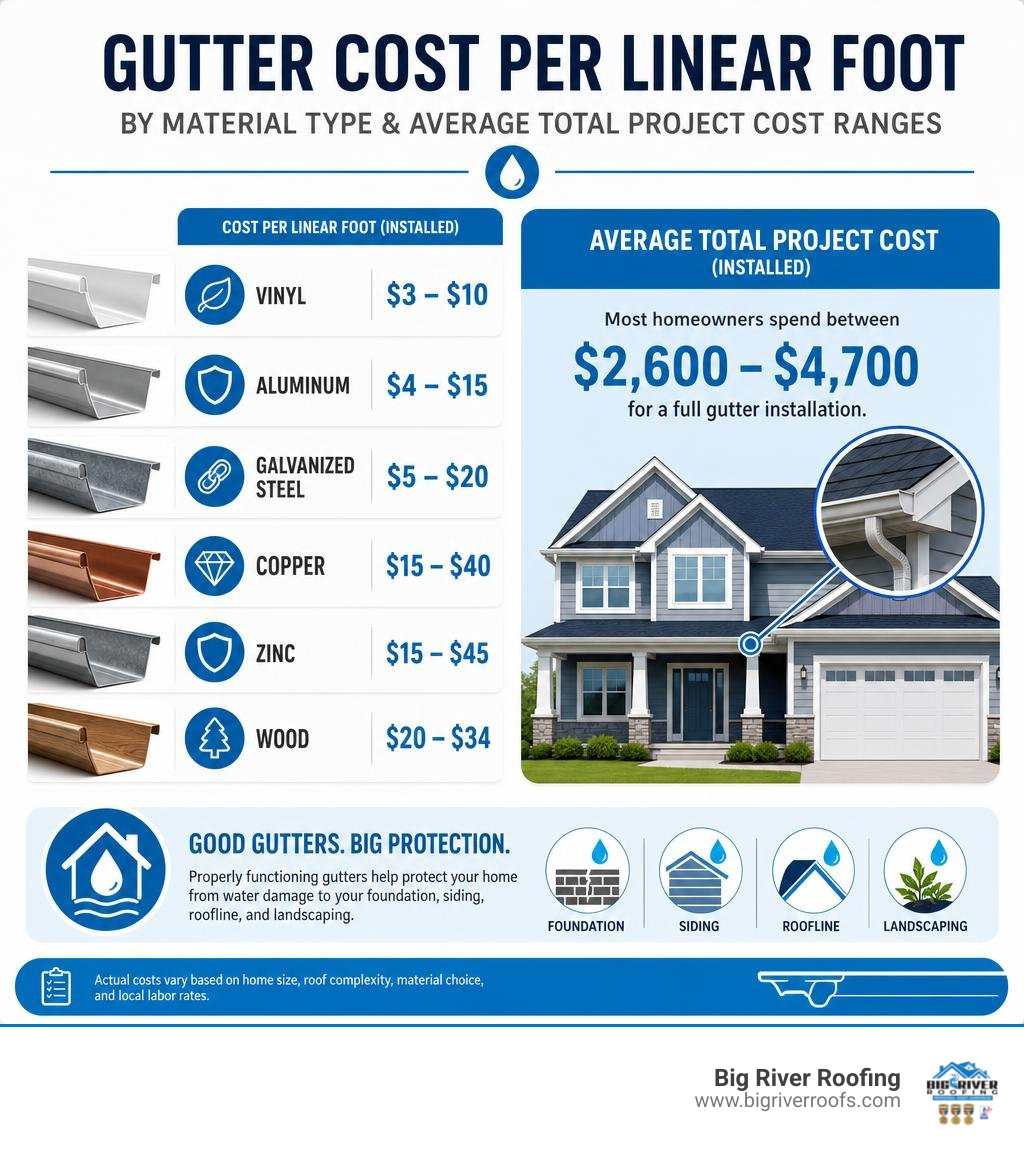
| Gutter Material | Cost per Linear Foot (Installed) |
|---|---|
| Vinyl | $3 – $10 |
| Aluminum | $4 – $15 |
| Galvanized Steel | $5 – $20 |
| Copper | $15 – $40 |
| Zinc | $15 – $45 |
| Wood | $20 – $34 |
Most homeowners spend between $2,600 and $4,700 for a full gutter installation. For a typical single-family home, replacing gutters runs around $4,000 when you factor in materials, labor, and removal of the old system.
Those numbers can shift a lot depending on your home’s size, roof complexity, and the material you choose. A small ranch in Western PA is a very different job than a two-story colonial with multiple roof angles.
If your gutters are pulling away from the fascia, leaking at the seams, or sending water straight down your foundation wall, the cost of not replacing them tends to be far higher than the installation itself. Foundation repairs alone can run $10,000 or more.
I’m Don Kovac, owner of Big River Roofing, and after years of installing and replacing gutters across Mercer, Lawrence, Butler, and Beaver Counties, I’ve seen how the cost of rain gutters per foot varies based on material, home height, and local labor rates. This guide breaks it all down so you can budget with confidence.
What is the Average Cost of Rain Gutters per Foot in 2026?
When budgeting for a gutter upgrade, looking at national averages only gets you so far. In 2026, the national median cost for a standard professional gutter installation ranges from $14 to $40 per linear foot. This range covers everything from basic, budget-friendly vinyl to high-end, custom-crafted copper. For the vast majority of homeowners in Western Pennsylvania, a standard 5-inch or 6-inch seamless aluminum system lands right in the sweet spot of $6 to $15 per linear foot installed.

Labor rates play a massive role in this pricing. Out of your total project estimate, the physical gutter material accounts for roughly 51% of the cost, while professional installation labor makes up about 23%. The remaining percentage goes toward essential accessories like downspouts, end caps, hangers, and the removal of your old, failing gutters.
To help you visualize how these numbers translate to a real-world budget, you can use the Gutter Installation Cost Calculator (2026) to get a baseline estimate. Below is a detailed breakdown of what you can expect to pay per foot depending on whether you take the DIY route or hire a professional team:
| Gutter Material | DIY Material Cost (Per Foot) | Professional Installed Cost (Per Foot) | Average Lifespan |
|---|---|---|---|
| Vinyl / PVC | $2.40 – $4.00 | $3.00 – $10.00 | 8 – 12 Years |
| Seamless Aluminum | N/A (Requires Pro Machine) | $6.00 – $15.00 | 20 – 30 Years |
| Galvanized Steel | $4.50 – $7.00 | $8.00 – $20.00 | 20 – 25 Years |
| Copper (K-Style) | $18.00 – $25.00 | $20.00 – $40.00 | 80 – 100+ Years |
| Zinc | $22.00 – $30.00 | $35.00 – $45.00 | 50+ Years |
Seamless vs. Sectional: Cost of Rain Gutters per Foot
One of the most important decisions you will make is choosing between traditional sectional gutters and modern seamless gutters.
Sectional gutters are sold in pre-cut 10-foot to 20-foot pieces that must be fastened together on-site using connectors and joints. While they are cheap and widely available at big-box home improvement stores, they have a major design flaw: seams. Over time, the sealant in these joints dries out, cracks, and begins to leak. In fact, roughly 15% of all gutter repairs are directly related to leaking seams.
Seamless gutters, on the other hand, are custom-fabricated on-site. Professional contractors bring a specialized roll-forming machine to your home and extrude a single, continuous piece of metal cut to the exact length of your roofline. Because they only have joints at the corners and downspouts, seamless gutters eliminate nearly 80% of potential leak points.
While seamless gutters cost slightly more upfront—typically adding $1 to $3 per linear foot over sectional systems—their long-term value is unmatched. They require far less maintenance, look incredibly clean, and last nearly twice as long as sectional systems. If you’re looking for real-world pricing trends right in our backyard, you can check out the typical costs for Seamless Gutters in Beaver Falls, PA to see how local rates compare.
How Material Choices Impact the Cost of Rain Gutters per Foot
Your choice of material is the single largest variable affecting the cost of rain gutters per foot. Let’s take a close look at the pros, cons, and lifespans of the six most popular options:
- Aluminum: The undisputed king of residential gutters. Aluminum is lightweight, completely rust-proof, and highly customizable with dozens of pre-painted color options. Standard 0.027-inch thick aluminum is great for mild climates, but in Western PA—where heavy winter snow and ice dams are common—we always recommend upgrading to heavy-duty 0.032-inch aluminum. It balances cost, durability, and performance perfectly, lasting 20 to 30 years.
- Vinyl (PVC): The cheapest option on the market. Vinyl gutters are rust-free and easy to snap together, making them popular for DIY projects. However, they do not handle the harsh Pennsylvania freeze-thaw cycles well. Extreme cold makes vinyl brittle, leading to cracks under heavy snow loads. With a short lifespan of just 8 to 12 years, you will likely end up replacing them three times over the lifespan of a single aluminum system.
- Galvanized Steel: If you need raw strength to combat heavy snow and high winds, galvanized steel is an excellent choice. These gutters are incredibly rigid and impact-resistant, lasting 20 to 25 years. The downside? They are heavy, challenging to install, and will eventually rust if the protective zinc coating is scratched or wears away.
- Copper: The ultimate luxury upgrade. Copper gutters never rust, require zero paint, and naturally develop a beautiful green patina over time. They are a legacy investment, easily lasting 80 to 100+ years. However, they require highly specialized soldering during installation and cost a premium ($20 to $40+ per foot).
- Zinc: Similar to copper, zinc is a premium, self-healing metal that forms a protective matte-gray patina. It is highly durable, rust-resistant, and lasts over 50 years. At $35 to $45 per foot, it is typically reserved for historic restorations or modern architectural homes.
- Wood: Usually made from cedar, redwood, or Douglas fir, wood gutters are rare today and mostly found on historic homes. They offer a beautiful, classic aesthetic but require annual oil treatments to prevent rot. At $20 to $34 per foot, they are a high-maintenance labor of love.
To compare these materials side-by-side based on your specific roof layout, you can run your numbers through this comprehensive Gutter Cost Calculator (2026).
Key Factors That Influence Your Gutter Installation Estimate
If two identical houses sit next to each other, their gutter estimates can still differ by hundreds of dollars. Why? Because material cost is only one piece of the puzzle.

When we evaluate a home for a gutter project in Western PA, we look at several local and structural variables. For instance, regional weather patterns require us to plan for heavy snow loads, meaning we must space our gutter hangers closer together (typically every 18 to 24 inches) than a contractor would in a warmer state. See how we set hanger spacing for snow loads on our page for gutter installation in Western PA.
Home Height and Roof Complexity
Getting water off your roof is a science, and the architecture of your home dictates how difficult that science is to apply.
- Home Height: Working on a single-story ranch is straightforward and safe. Once you move to a two-story or three-story home, the labor rates increase. Multi-story installations typically add a $1 to $3 per foot labor premium. This is because our crew must use specialized safety harnesses, taller ladders, and sometimes scaffolding or mechanical lifts (which can add $400 to $1,200 to a job if access is tight).
- Roof Pitch and Complexity: A roof with a steep pitch causes rainwater to rush down at high speeds, often requiring larger 6-inch gutters instead of standard 5-inch ones to prevent overflow. Furthermore, complex rooflines with multiple valleys, dormers, and gables require more mitered corners, extra end caps, and custom fittings. Every corner joint requires precise cutting and sealing, which increases labor time.
Existing Gutter Removal and Fascia Repair
If you are replacing old, sagging gutters, we can’t just slap the new ones on top. The prep work is critical to ensuring your new system lasts.
- Tear-Off and Disposal: Safely removing and disposing of your old gutters typically costs between $0.50 and $1.50 per linear foot. This includes the labor to carefully pry the old brackets loose without damaging your roofing shingles or siding.
- Fascia Board Repair: This is where many budget installations fail. When gutters clog and overflow, water backs up behind the gutter and rots the wood fascia board (the horizontal board your gutters are mounted to). If we mount new gutters to rotted wood, the screws will eventually pull loose, causing the entire system to collapse under the weight of winter snow. Replacing rotted fascia boards typically adds $6 to $20 per linear foot. If your roof has suffered water damage from failing gutters, check out our roof repair services to see how we can restore your home’s structural integrity.
- Drip Edge Retrofitting: A drip edge is a L-shaped or Type D metal flashing installed along the edge of your roof. It directs water away from the fascia and straight into the gutter. If your home lacks a drip edge, water will seep behind the gutters, rotting your fascia and causing dark, ugly stains on your siding. Adding a drip edge during a gutter replacement is one of the smartest ways to protect your investment.
Additional Components and Long-Term Gutter Costs
When you receive a professional estimate, make sure it includes all the necessary accessories. A functioning water management system is much more than just the horizontal troughs lining your roof.
When reviewing your estimate, ensure there are no hidden fees for downspouts, elbows, or brackets. To understand what a complete, transparent estimate looks like in our region, you can review this guide on How Much Do New Gutter Installations Cost in PA?.
Downspouts, End Caps, and Gutter Guards
To keep water moving safely away from your foundation, several key components must work in harmony:
- Downspouts: These vertical pipes carry water from the gutters down to the ground. As a rule of thumb, you need one downspout for every 30 to 40 feet of gutter run to prevent backing up. Standard aluminum downspouts cost between $15 and $25 each, while premium materials or decorative rain chains can run much higher.
- Gutter Guards: If your home is surrounded by beautiful Pennsylvania hardwoods, gutter guards are a lifesaver. They prevent leaves, pine needles, and twigs from entering the trough while allowing water to flow freely. Basic mesh guards cost $1 to $3 per foot, while professional-grade micro-mesh guards run $7 to $15 per foot installed. While they add to your upfront cost, they can extend the lifespan of your gutters by 30% to 50% and eliminate the need for biannual gutter cleaning (which typically costs $150 per visit).
- Runoff Management: Simply dropping water at the corner of your house isn’t enough. We use downspout extensions or splash blocks to direct water at least 3 to 5 feet away from your foundation. In areas prone to severe storms, integrating your gutters with proper drainage is essential. If you have recently experienced storm damage, you can read more about our storm damage roofing services to see how we help homeowners recover.
Frequently Asked Questions About Gutter Replacement
We hear many of the same questions from homeowners planning their gutter projects. Here are honest, straightforward answers to help you make the right choice.
Are seamless gutters worth the extra money?
Absolutely. While seamless gutters cost about 15% to 30% more upfront than sectional gutters, they are worth every penny. By eliminating seams along the straight runs of your roof, you eliminate the primary cause of gutter leaks and sagging. They require significantly less maintenance, have a much cleaner aesthetic that boosts your home’s curb appeal, and easily last 20 to 30 years compared to the 10-year lifespan of sectional systems. Over a 30-year ownership horizon, seamless gutters are actually the more cost-effective choice.
How many linear feet of gutters does a typical home need?
The average single-family home in Western PA requires between 150 and 200 linear feet of gutters, along with 3 to 4 downspouts.
To estimate your own home’s needs, you can calculate the footprint of your roofline. Walk the perimeter of your home and measure the length of the eaves (the edges of the roof where water runs off). Sum these measurements up and add about 10% to account for waste, cutting, and corner miters. You don’t always need gutters on every side of your house—only on the eaves where the roof slopes downward.
Is gutter installation a DIY project or should I hire a pro?
While you can buy vinyl or aluminum sectional gutter kits at a local hardware store, we highly recommend hiring a professional for several reasons:
- Safety: Working on tall ladders while handling long, awkward metal troughs is incredibly dangerous. Falls from ladders are one of the leading causes of home improvement injuries.
- Specialized Equipment: Seamless gutters cannot be DIYed because they require a commercial roll-forming machine that costs thousands of dollars.
- Precise Pitching: Gutters must be sloped precisely (usually 1/4 inch of drop for every 10 feet of run) toward the downspouts. If the pitch is off even slightly, water will pool in the middle, causing the gutter to sag, overflow, and rust prematurely.
- Warranties: Improper DIY installation can void your roof’s warranty if you accidentally damage the starter shingles or drip edge. Professional installation comes with workmanship and material warranties that protect your home for years to come.
Conclusion
New gutters may not be the most glamorous home improvement project, but they are one of the most critical investments you can make to protect your home’s foundation, siding, and landscaping from costly water damage.
At Big River Roofing, we are proud to serve homeowners throughout Hermitage, Mercer, Lawrence, Butler, Beaver, and Allegheny Counties. As a local, family-owned Western Pennsylvania contractor, we specialize in manufacturer-certified installations with top-tier materials from brands like IKO, Owens Corning, and CertainTeed. We pride ourselves on honest communication, transparent pricing, and quality craftsmanship.
Ready to find out the exact cost of rain gutters per foot for your unique home? Contact us today to Schedule a professional consultation for new gutters and receive a free, comprehensive inspection. We’ll make sure your home stays dry and protected through every Pennsylvania season!