Address: 2404 E State St, Hermitage, PA 16148, United States
Phone Number: (724) 877-7380
Email Address: donkovac018@gmail.com
Business Hours:
Monday: 9:00 AM To 5:00 PM
Tuesday: 9:00 AM To 5:00 PM
Wednesday: 9:00 AM To 5:00 PM
Thursday: 9:00 AM To 5:00 PM
Friday: 9:00 AM To 5:00 PM
Saturday: 9:00 AM To 1:00 PM
Sunday: Closed
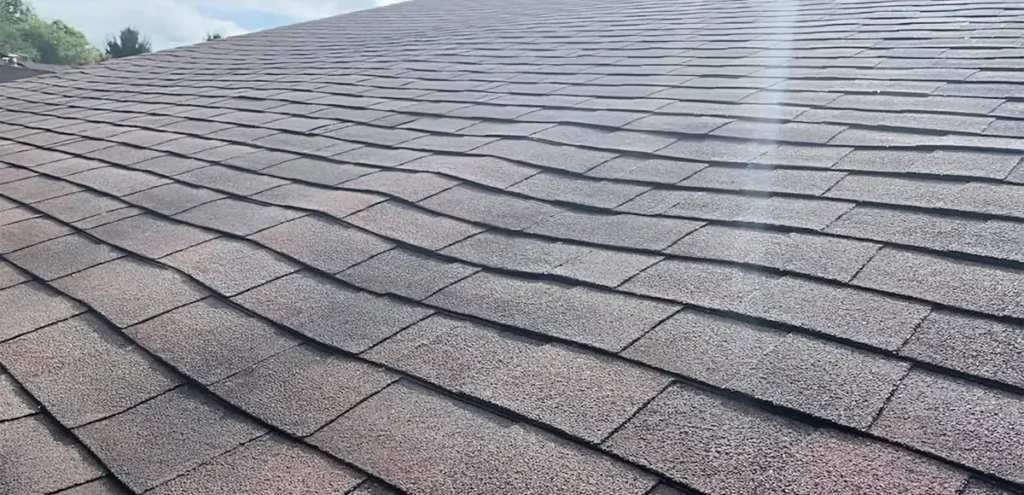
A structural roof problem in Hermitage rarely starts as a structural problem. It starts as a slow leak around a chimney, an ice dam at the eaves, or a pipe boot that cracked five winters ago. Water gets into the deck, sits in the insulation, and works on the rafters and sheathing one freeze-thaw cycle at a time. By the time the homeowner notices a sag in the ridge or a dip in the field, the damage has been spreading for years.
Big River Roofing is a local roofing contractor based at 2404 E State St in Hermitage, PA. Our certified crew handles structural roof repair on residential homes across Mercer, Lawrence, Butler, and Beaver Counties. Five years in business, and a structural repair process that addresses the visible damage and the underlying cause so the problem does not come back.
Call (724) 877-7380 or request a free structural roof inspection to get started.
Most roofing repairs are surface-level work: shingles, flashing, sealants, and underlayment. Structural roof repair is different. It deals with the framing and decking that hold the roof up, the components that take loads from snow, wind, and gravity year after year. When any of those components fail, the integrity of the whole roof system is at risk, and a surface-level repair will not fix it.
Structural problems we handle on Hermitage homes include rotted or delaminated roof decking, sagging ridge lines, sagging valleys, dipped or uneven roof planes, broken or cracked rafters, damaged collar ties or rafter ties, sinking sections around skylights or chimneys, and complete deck failure from long-term moisture intrusion. Each of these calls for opening up the affected area, replacing the damaged framing or sheathing, and rebuilding the roof system from the deck up.
Roofs in Mercer County deal with stresses that homes in milder climates do not. Understanding what causes structural problems in Hermitage helps homeowners catch the warning signs before the damage spreads.
The most common cause of structural roof damage we see in Hermitage is a slow leak that went undetected for years. A cracked pipe boot, a failed flashing detail, or a worn underlayment in a valley lets a small amount of water into the deck on every rain. The water soaks into the OSB or plywood, the wood swells and contracts through the freeze-thaw cycle, and over time the sheathing delaminates and loses its strength. The rafters underneath start to rot at the connection points, and the whole section of roof begins to sag.
This is why we always inspect the attic during a leak detection or roof repair call. Catching a slow leak in year two saves the deck. Catching it in year ten often means a structural repair.
Western Pennsylvania gets meaningful snowfall, and the National Weather Service averages around 40 inches per year for the Pittsburgh region. A foot of wet snow weighs roughly 20 pounds per square foot, and a typical Hermitage roof can carry that load without issue when the framing was built to code and is in good condition. The problem comes when the rafters are already weakened by moisture damage or were undersized for the span at the time of construction. Heavy snow accelerates the failure that was already in progress.
Ice dams form when heat escapes through a poorly ventilated attic, melts snow at the ridge, and lets the water refreeze at the colder eaves. The ice itself is heavy, but the bigger problem is the water that backs up under the shingles and into the deck. Repeated ice dam events over multiple winters work on the same section of decking and rafters, and the damage compounds. Sagging eaves and dips above the gutter line are often the visible result.
Some structural problems trace back to how the roof was framed in the first place. Rafters that were undersized for the span, missing collar ties or rafter ties, decking that was nailed with insufficient fasteners, or load-bearing walls that were removed during a renovation without proper structural reinforcement all show up as roof sag eventually. Older homes in Hermitage and the surrounding communities sometimes need engineering work in addition to repair work to bring the roof framing back to code.
Termites and carpenter ants do not get the attention in Pennsylvania that they get in southern states, but they do appear in Mercer County, and they can cause real damage to roof framing over time. A rafter weakened by carpenter ant tunneling can crack under snow load even if the moisture damage was not severe. We look for evidence of pest damage during structural inspections, especially in older homes or in any home where pest activity has been documented elsewhere.
A fallen tree, a large branch, or a major wind event can damage roof framing in a single moment. The impact may crack a rafter, shift the sheathing, or knock the ridge out of alignment. According to NOAA’s Storm Events Database, Mercer County regularly experiences wind events capable of causing direct structural damage to residential roofs. These cases call for immediate inspection because the structural integrity of the roof is compromised, and additional collapse risk depends on how the load is distributed across the remaining framing.
Some structural roof issues are obvious from the street. A visibly bowed ridge line, a clear dip in the field of the roof, or a sagging eave is hard to miss. Other signs are subtler and call for an experienced eye. Schedule an inspection from Big River Roofing if you notice any of these warning signs:
Several of these signs (sticking doors, drywall cracks, uneven snow melt) indicate that the roof framing is moving, which means the structural problem has progressed to the point where the load distribution in the house is shifting. These are not signs to ignore until spring.
Even a minor sag in a Hermitage roof can indicate underlying structural damage that worsens with every freeze-thaw cycle and snow load. The table below helps homeowners across Mercer, Lawrence, Butler, and Beaver Counties assess the severity of their sagging roof and understand how urgently they need to act.
Sag Description | Visible Signs | Likely Structural Cause | Urgency Level | Recommended Action |
Slight wave or ripple in roof field | Minor undulation visible only up close | Early deck delamination or fastener failure | Low to Moderate | Schedule inspection within 30 days |
Dip above gutter line at eaves | Subtle depression along roof edge | Ice dam damage to eave framing over multiple winters | Moderate | Schedule inspection before next winter season |
Visible dip in roof field from street | Clear depression noticeable from ground level | Deck delamination from long-term moisture intrusion | Moderate to High | Schedule inspection within 1 to 2 weeks |
Uneven roof planes visible from street | One section sits lower than adjacent sections | Multiple rafter compromise or improper original framing | High | Schedule inspection within 1 week |
Sagging valley between two roof planes | Depression visible along roof valley line | Valley underlayment failure with long-term deck saturation | High | Schedule inspection within 1 week |
Visibly bowed ridge line | Ridge sags at center or along its length | Ridge board rot or failure at multiple rafter connections | High | Schedule inspection within 48 hours |
Roof spongy or flexes underfoot | Deck gives way under foot pressure when walked | Advanced deck delamination across affected section | High | Schedule emergency inspection within 48 hours |
Rapid sag progression over weeks | Sag visibly worse from month to month | Active structural failure under ongoing load | Critical | Call (724) 877-7380 immediately |
Ceiling bowing downward in upper rooms | Interior ceiling visibly pushing downward | Deck or rafter failure directly above living space | Critical | Call immediately, avoid affected area |
Sag accompanied by cracking sounds | Audible cracking or popping from attic | Active framing failure under load | Critical | Call immediately, vacate affected area |
Sag after recent storm or fallen tree | Sudden new sag following weather event | Direct impact damage to rafters or ridge | Critical | Call immediately |
Sag with sticking doors and drywall cracks | Upper floor doors stick, corner cracks appear | Load redistribution from failing roof framing into walls | Critical | Call immediately, structural assessment required |
Structural roof repair is more involved than surface roofing work, and our process reflects that. Here is what to expect from first inspection to final walkthrough:
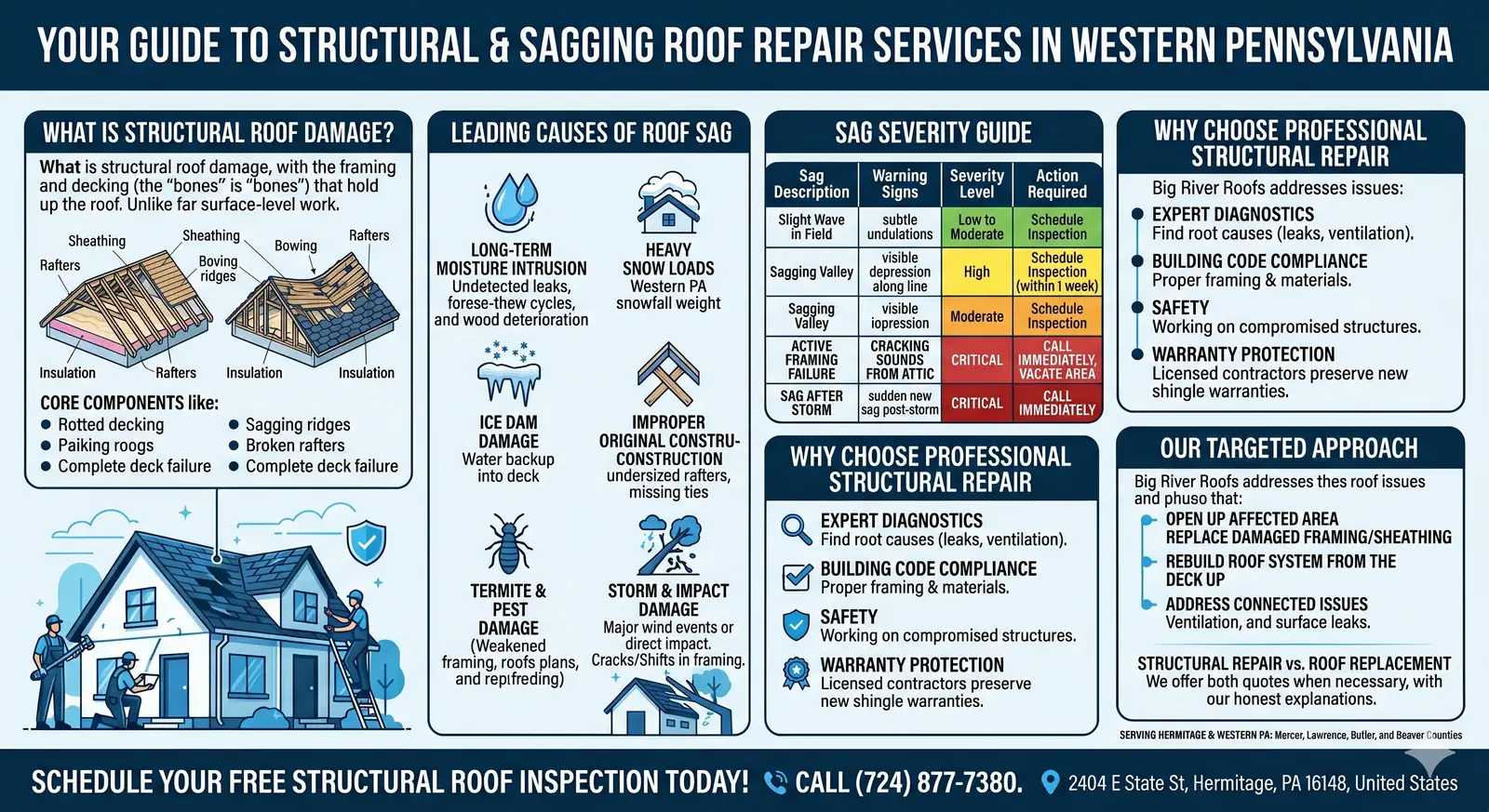
Most structural roof problems we see in Hermitage can be addressed with targeted repair: open up the affected area, replace the damaged framing and sheathing, and rebuild the roofing surface above. The roof goes back to full structural integrity, and the homeowner gets another decade or more out of it.
But there are cases where structural repair is not the right answer, and we tell homeowners when they apply. If the damage covers a large percentage of the deck, if multiple rafters are compromised across different sections, if the roof is at end-of-life on the shingles anyway, or if the moisture damage has spread beyond what targeted repair can address, roof replacement is usually the better investment. Spending $8,000 on structural repair to a roof that needs $14,000 of replacement work in two years is money lost.
We give homeowners both quotes when this is the case, with photos and an honest explanation of the tradeoffs. The decision is yours either way.
One of the most important determinations Big River Roofing makes on every structural inspection is whether targeted repair or full replacement is the better investment for the homeowner. The table below outlines the key factors that point toward each outcome, helping homeowners in Hermitage and surrounding communities understand the decision before the inspection conversation begins.
Factor | Points Toward Structural Repair | Points Toward Full Replacement |
Damage extent | Isolated to one or two sections of deck or framing | Widespread across multiple sections or whole roof |
Shingle condition | Mostly intact with years of life remaining | At or past end of expected lifespan |
Number of compromised rafters | 1 to 4 rafters in a single area | Multiple rafters across different sections |
Roof age | Under 15 years old | 20 years or older |
Repair cost vs replacement cost | Repair cost below 50% of replacement cost | Repair cost approaching or exceeding replacement cost |
Moisture spread | Contained to visible damage area | Widespread through insulation and multiple framing members |
Shingle granule loss | Minimal, localized | Heavy loss throughout gutters |
Prior repair history | First structural issue on otherwise sound roof | Repeated repairs with recurring structural problems |
Structural engineer assessment | Targeted repair confirmed adequate | Engineer recommends full rebuild |
Insurance coverage | Storm damage covered under policy | Age-related exclusion limits reimbursement |





Structural roof problems almost always tie back to other issues that need to be addressed at the same time, or the structural repair will fail again within a few years. Our inspection looks at the connected systems and addresses them as part of the scope.
A slow leak that caused the original deck damage needs to be traced and fixed. Our leak detection service finds the source of the water intrusion, and the repair includes whatever flashing, pipe boot, or underlayment work is needed to keep water out going forward.
Surface damage that contributed to the structural problem (missing shingles, failed flashing, worn underlayment) gets addressed as part of the broader roof repair service. Repairing the deck without fixing the surface that allowed water in is a short-term fix at best.
Storm-related structural damage from wind, hail, or impact is documented as part of our storm damage roofing service, and we coordinate with the homeowner’s insurance carrier to support the claim. Most standard Pennsylvania homeowner policies cover sudden structural damage from a storm event but exclude long-term moisture damage, so the documentation matters.
Inadequate attic ventilation is a frequent contributor to ice dams and the structural damage they cause. When we find it, we recommend ventilation improvements as part of the structural repair so the underlying cause does not produce the same problem again next winter.
Surface roof repairs (a missing shingle, a cracked pipe boot) are sometimes within a homeowner’s ability if they have the experience and the safety equipment. Structural roof repair is not. Working on compromised framing means working on a roof system whose load capacity is unknown, and a misstep can cause additional collapse, serious injury, or both. Cutting into a rafter or removing a section of decking without understanding the load path can shift the structural integrity of the entire roof.
Structural repair also requires knowledge of building codes, framing techniques, and the right materials for the application. Sister rafters need to be sized and fastened correctly. Replacement sheathing needs to span properly across the rafter spacing. Ice and water shields need to cover the right area to keep the same problem from recurring. Each of these is a skill that takes years to develop, and the consequences of getting it wrong are much higher than on a surface repair.
Insurance carriers also typically require a licensed contractor to perform structural repairs covered under a claim, and a DIY repair will void the manufacturer warranty on any new shingles installed afterward. The cost of professional structural repair is small compared to the cost of getting it wrong.
Big River Roofing provides certified structural and sagging roof repair services to homeowners and property owners throughout the entire Western Pennsylvania service area. Our service areas include: Mercer County, Lawrence County, Butler County, Beaver County, Cranberry Township, Harmony, Wexford, Slippery Rock, Butler, Beaver, Grove City, New Castle, Neshannock, Mercer, Sharon, Hermitage, Ellwood City, West Middlesex, Beaver Falls, Warrendale and surrounding communities. Explore our complete list of coverage zones on our Service Areas page.
Whether you are dealing with a sagging roof deck in Hermitage, rotted rafters in New Castle, or ice dam structural damage in Cranberry Township, the team is locally based, licensed, and equipped to assess and repair the full scope of structural damage correctly.
A sagging roof or a damaged deck is not a problem that improves on its own. Every freeze-thaw cycle works on the damage, and every snow load adds stress to framing that is already compromised. Big River Roofing offers free structural roof inspections and written quotes across Hermitage and Western Pennsylvania, with no pressure and no obligation until you are ready to move forward.
Call (724) 877-7380 or request a free structural roof inspection online to schedule with a certified local contractor.
Address: 2404 E State St, Hermitage, PA 16148, United States
Phone Number: (724) 877-7380
Email Address: donkovac018@gmail.com
Business Hours:
Monday: 9:00 AM To 5:00 PM
Tuesday: 9:00 AM To 5:00 PM
Wednesday: 9:00 AM To 5:00 PM
Thursday: 9:00 AM To 5:00 PM
Friday: 9:00 AM To 5:00 PM
Saturday: 9:00 AM To 1:00 PM
Sunday: Closed
Structural roof repair costs vary widely based on the scope of damage. Smaller repairs involving a single section of damaged decking and a couple of sister rafters typically run $1,500 to $4,000. Larger repairs involving multiple rafters, significant deck replacement, or related ventilation work can run $5,000 to $12,000 or more. Repairs that approach the cost of full replacement often make replacement the better investment. Big River Roofing provides a written quote after every inspection so you know the cost before any work starts.
Most structural repairs in Hermitage take two to five days, depending on the scope. Smaller deck and rafter repairs can be completed in a single day, while larger jobs involving multiple sections of framing, related ventilation work, or roofing replacement above the repair can take a full week. We provide a written timeline with the quote before scheduling.
It depends on the cause of the damage. Most standard Pennsylvania homeowner policies cover sudden structural damage from wind, hail, fallen trees, or impact events. Long-term damage from slow leaks, neglected maintenance, or normal wear is typically excluded. If the structural damage was caused by a recent storm event, our insurance claims assistance can document the cause and support your claim. The Pennsylvania Insurance Department has public resources on homeowner coverage if you want to review your policy basics.
A roof can collapse in extreme cases, especially under heavy snow load if the framing is significantly compromised. Most sagging roofs in Hermitage are not at imminent collapse risk, but they will continue to deteriorate until the underlying damage is repaired. Once doors and windows on the upper floor start sticking, drywall cracks appear, or the sag becomes visibly worse over time, the structural problem has reached a point where repair should not be delayed.
Most structural roof repairs in Western Pennsylvania do not require an engineer. Standard sister-rafter repairs, deck replacement, and ventilation improvements are within the scope of a qualified roofing contractor. An engineer becomes necessary when the damage covers a large area, when multiple rafters are compromised across different sections, when load-bearing walls have been altered, or when the original framing was built to non-standard specifications. We tell you upfront if engineering work is needed and coordinate with engineers in the Mercer County area when it is.
Long-term moisture intrusion from undetected leaks is the leading cause of structural roof damage we see in Hermitage. A small leak that went unaddressed for years allows water to soak into the deck and rafters, and the freeze-thaw cycle accelerates the deterioration. Heavy snow loads, repeated ice dam damage, and improper original construction also contribute, especially on older homes.
Yes, in most cases. Targeted repair of damaged decking and rafters, combined with addressing the underlying cause, restores the roof to full structural integrity without full replacement. Roofs that have widespread structural damage, end-of-life shingles, or moisture issues that have spread beyond targeted repair are usually better candidates for replacement. We give you both options when both apply.
Surface damage shows up as missing shingles, visible flashing problems, or interior leaks without changes to the roof shape. Structural damage shows up as sag in the ridge or field, dips along the eaves or valleys, soft spots underfoot, doors or windows that have started to stick, or daylight visible through the roof boards in the attic. A structural inspection from Big River Roofing identifies which type of damage you are dealing with and what the repair scope looks like.
In most cases, yes, but it depends on the severity. A small dip in the field that has been there for years and is not getting worse is not an immediate safety concern. A visibly sagging ridge that has gotten worse over recent months, especially heading into winter, is a different situation. If the sag is significant or progressing, schedule an inspection right away and avoid the affected upper-floor rooms in extreme weather until the structural integrity is confirmed.
The most effective prevention is annual roof inspections to catch leaks early, before they cause structural damage. Other steps include keeping gutters clean to prevent ice dam formation, ensuring proper attic ventilation to reduce heat loss, addressing any roofing repair promptly, and monitoring the attic for signs of moisture after major storms. A roof in good condition with proper ventilation and maintenance rarely develops structural problems within its design lifespan.
Your roof protects everything underneath it. If it’s been a few years since your last inspection, or a recent storm rolled through your area, now is the right time to get a professional set of eyes on it before a small problem becomes a costly one.
Reach out to Big River Roofing and let a certified local contractor give you a straight answer about what your roof needs. No sales pressure, no inflated estimates, just clear information and honest recommendations from a team that has been serving Hermitage and Western Pennsylvania homeowners for 5+ years.