Address: 2404 E State St, Hermitage, PA 16148, United States
Phone Number: (724) 877-7380
Email Address: donkovac018@gmail.com
Business Hours:
Monday: 9:00 AM To 5:00 PM
Tuesday: 9:00 AM To 5:00 PM
Wednesday: 9:00 AM To 5:00 PM
Thursday: 9:00 AM To 5:00 PM
Friday: 9:00 AM To 5:00 PM
Saturday: 9:00 AM To 1:00 PM
Sunday: Closed
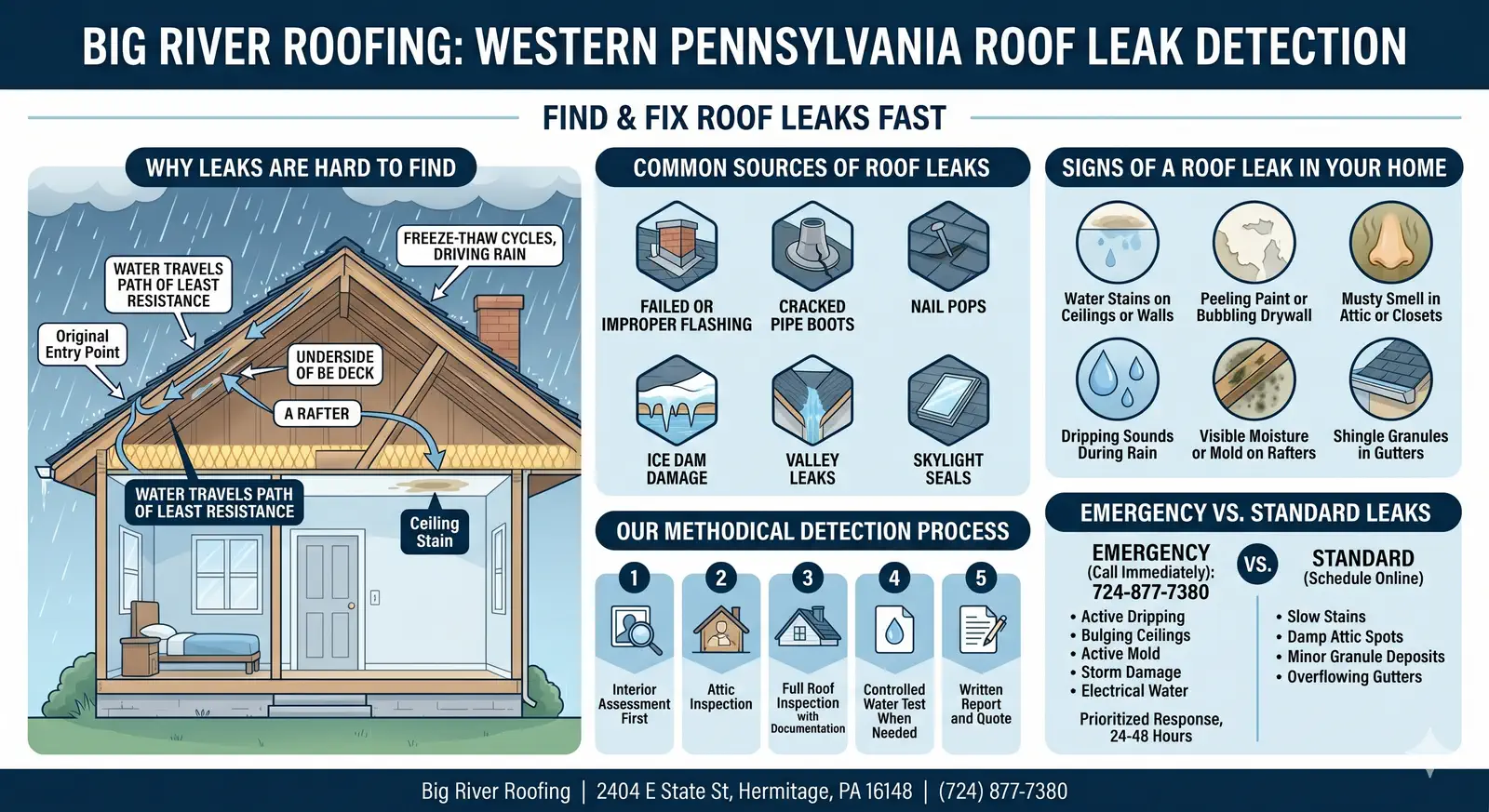
A roof leak in Hermitage does not always show up where the water enters the roof. By the time a stain appears on the ceiling, water has often traveled across the underside of the deck, run along a rafter, and dropped through the insulation several feet from the source. Finding the true point of entry takes more than a quick look at the shingles above the stain. It takes a methodical inspection, the right tools, and someone who has seen what Western Pennsylvania weather does to a roof.
Big River Roofing is a local roofing contractor based at 2404 E State St in Hermitage, PA. Our certified crew handles roof leak detection on residential homes across Mercer, Lawrence, Butler, and Beaver Counties. Five years in business, and a leak detection process built on real inspections, photos, and written quotes before any repair work starts.
Call (724) 877-7380 or request a free roof leak inspection to get started.
The challenge with a roof leak in Hermitage is that water does not move in a straight line. It follows the path of least resistance: down a rafter, across the underside of the deck, along a wire run, behind the insulation. A leak that looks like it is coming from a spot in the bedroom ceiling may have started ten feet up the slope, on the other side of the chimney.
Western Pennsylvania weather makes the problem worse. Driving rain in the spring forces water under shingle tabs that look fine from the ground. Snow melt during a January thaw refreezes at the eaves and pushes water back up under the shingles in places that were never meant to be wet. A summer thunderstorm dumps two inches of rain in 30 minutes and overwhelms a clogged gutter, sending water back behind the fascia and into the soffit. Each of these is a different leak with a different fix, and each one takes a trained eye to identify.
Hermitage homes also have to deal with the freeze-thaw cycle. The U.S. Climate Data record shows average January lows below 20°F with regular swings into the upper 30s, which is the range that opens and closes seams over and over. Caulk that held for ten years finally cracks. A pipe boot collar splits along the rubber. A nail pop lifts a shingle just enough to let water in. By the time you see the leak inside the house, the failure may have started a year earlier.
We have inspected enough roofs in Mercer, Lawrence, Butler, and Beaver Counties to know where Western Pennsylvania leaks tend to come from. The list below covers the most common sources we trace.
Flashing covers the joints where the roof meets a chimney, sidewall, skylight, or roof-to-wall transition. When it was installed with a heavy bead of caulk instead of step flashing tied into the shingle courses, it would fail. Once the caulk cracks from freeze-thaw cycles, water runs straight down the wall and into the house. Flashing leaks are one of the most common sources we find on Hermitage homes built or re-roofed in the 1990s and early 2000s.
The rubber collar around a plumbing vent stack has a shorter lifespan than the shingles around it. UV exposure cracks the rubber, and once it splits, water runs down the pipe and into the attic. Pipe boots are one of the most common leak sources we find on Hermitage homes that are 12 years old or older, and the fix is one of the cheapest repairs we do.
Over time, the framing in a house expands and contracts, and roofing nails can back out of the deck. A nail pop lifts the shingle just enough to break the seal, and water finds its way under the tab. Nail pops are easy to miss from the ground and call for an attic inspection to confirm.
The underlayment is the second line of defense behind the shingles. When the shingles seal and the underlayment is intact, the roof can shed even heavy wind-driven rain. When the underlayment has worn through from age or was the cheapest 15-pound felt available at the time of install, water finds its way through nail holes and seams to the deck below.
Ice dams form when heat escapes through a poorly ventilated attic, melts snow at the ridge, and lets the water refreeze at the colder eaves. The dam pushes water back up under the shingles, where it finds nail holes and seams. According to the U.S. Department of Energy, proper attic insulation and ventilation is the most effective long-term prevention for ice dam formation in cold climates. Ice dam leaks are some of the most common winter calls we get in Hermitage and the surrounding communities.
Skylight flashing kits have rubber and metal components that fail at different rates. The flashing pan rusts, the rubber gasket dries out, and the seam between the skylight and the deck opens up. A skylight that was watertight for 15 years can start leaking in a single season.
A chimney without a real cricket on the upslope side traps debris and water, and the constant moisture rots the flashing over time. Counter flashing that was tucked into a mortar joint and sealed with a bead of caulk pulls loose over time, and water runs straight down inside the wall.
Valleys handle more water than any other section of the roof. When the underlayment was not extended far enough up the slope, or when the shingles were cut too close to the centerline, water cuts a path under the roofing and into the deck. Valley leaks often show up as stains in interior corners or along stairwells, far from where the water entered.
Some leaks are obvious. A drip in the kitchen during a thunderstorm leaves no doubt that water is getting in somewhere. Other leaks are slower and easier to miss until they have caused real damage. Here are the signs that warrant a leak detection inspection from Big River Roofing:
If any of these apply to your home, schedule an inspection before the next round of weather comes through. A small leak handled now is much cheaper than the structural and interior damage that comes from waiting a season.
Even small roofing issues in Western Pennsylvania can escalate quickly given the region’s heavy snowfall, freeze-thaw cycles, and active storm seasons. The table below helps homeowners across Mercer, Lawrence, Butler, and Beaver Counties identify the severity of their roof leak warning signs and know exactly what to do next.
Warning Sign | Severity | Likely Cause | Immediate Action |
Water actively dripping into living space during rain | Critical | Failed flashing, cracked shingles, or open deck | Call (724) 877-7380 immediately |
Ceiling bulging or sagging with trapped water | Critical | Significant ongoing water saturation above ceiling | Call immediately, do not puncture ceiling yourself |
Water near electrical fixtures or outlets | Critical | Active leak reaching wiring above ceiling | Call immediately, shut off power to affected area if safe |
Visible roof deck damage from storm or fallen tree | Critical | Direct impact damage to roof structure | Call immediately for emergency tarp and inspection |
Active mold growth visible in attic or upper rooms | Critical | Long-term undetected moisture intrusion | Call immediately, mold spreads rapidly in attic conditions |
Large ice dam with water backing into living space | High | Poor attic insulation and ventilation | Call for emergency inspection before next freeze cycle |
Fresh water stain on ceiling after recent storm | High | Wind or hail damage to shingles or flashing | Schedule inspection within 24 to 48 hours |
Missing shingles visible from ground after wind event | High | Wind uplift breaking adhesive seal strip | Schedule inspection within 48 hours |
Daylight visible through attic roof boards | High | Compromised deck or shingle system failure | Schedule inspection within 48 hours |
Lifted or separated chimney or sidewall flashing | High | Freeze-thaw movement or age-related failure | Schedule repair before next rain event |
Cracked or split pipe boot collar visible on roof | High | UV degradation of rubber collar over time | Schedule repair before next rain season |
Water stain near skylight frame | High | Skylight seal or flashing pan failure | Schedule inspection within 1 week |
Ceiling stain that has grown larger over winter | Moderate | Slow ongoing leak worsening with each freeze-thaw | Schedule standard inspection within 2 weeks |
Damp insulation in attic without active dripping | Moderate | Slow chronic leak tracking through deck | Schedule standard inspection within 2 weeks |
Musty smell in attic or upper closets | Moderate | Moisture buildup from slow undetected leak | Schedule standard inspection within 30 days |
Peeling paint or bubbling drywall on upper walls | Moderate | Chronic moisture intrusion from slow leak above | Schedule standard inspection within 30 days |
Granule loss visible in gutters or downspouts | Moderate | Shingles approaching end of effective lifespan | Schedule inspection within 30 days |
Gutters overflowing without visible interior damage | Moderate | Debris blockage causing water backup at fascia | Schedule gutter and roof inspection within 30 days |
Spike in heating or cooling bills without explanation | Low to Moderate | Wet insulation losing R-value from slow leak | Schedule attic and roof inspection at next opportunity |
Algae or moss growth on roof surface | Low | Moisture retention accelerating shingle degradation | Schedule inspection at next seasonal maintenance interval |
Roof age over 15 years with no recent inspection | Low | Normal material aging approaching end of lifespan | Schedule preventive inspection before next storm season |
Big River Roofing follows a methodical process to find the true source of a roof leak. Here is exactly what that process looks like from start to finish:
Once we find the source of the leak, the repair work depends on the cause. A cracked pipe boot can be replaced in under an hour. A failed flashing detail takes a couple of hours and a few courses of new shingles. A worn-through underlayment in a valley calls for opening up the section and rebuilding it from the deck up.
Most roof leak repairs in Hermitage fall into our roof repair service and are completed in a single day. Larger repairs involving deck rot or rafter damage may require structural roof repair or, in some cases, a full roof replacement.
If the leak was caused by a recent storm, our storm damage roofing service walks you through the inspection, documentation, and insurance claim process. According to the Pennsylvania Insurance Department, most standard Pennsylvania homeowner policies cover sudden storm damage but exclude wear and tear, so the documentation matters.
Homeowners often try to find a roof leak on their own, and most of the time it goes one of two ways. Either the source stays hidden and the water keeps coming, or the homeowner finds something that looks suspicious, applies a tube of roof cement to it, and watches the leak get worse over the next few weeks.
The reason is the same in both cases. The visible damage is often not the source. Water travels along rafters and decks, and the entry point can be ten feet from the stain. Roof cement applied to the wrong spot traps water under the shingles, and the leak finds another path. A roof leak that has been chased with caulk and tar for two years is a more expensive repair than the original problem would have been.
A certified roofing contractor with experience in Western Pennsylvania conditions can find the source on the first inspection in most cases. Big River Roofing has handled hundreds of leaks across Mercer, Lawrence, Butler, and Beaver Counties, and we have seen the patterns. We know where the typical leaks are on a 1990s split-level in Hermitage, on a center-hall colonial in Sharon, and on a ranch with a low-slope addition in New Castle. Pattern recognition saves time, and time on a leak detection means less interior damage to repair.
According to OSHA, roofing is one of the highest-risk construction trades for fall-related injuries, which is another reason homeowners are better served leaving roof access to a certified professional.
Some roof leaks call for an inspection at the next available appointment. Others require an immediate response. Here is how to tell the difference:
Call Big River Roofing right away at (724) 877-7380 if:
For these situations, Big River Roofing prioritizes emergency calls and aims to be on site within 24 to 48 hours. In some cases an emergency tarp can be installed the same day to stop the water until a permanent repair is scheduled, buying time and preventing further interior damage while parts are sourced or a full inspection is completed.
Schedule a standard leak detection inspection if:
For non-emergency situations, request an inspection online and a team member will get back to you the same business day.





Big River Roofing provides professional roof leak detection and repair services to homeowners throughout the entire Western Pennsylvania service area. Our service areas include: Mercer County, Lawrence County, Butler County, Beaver County, Cranberry Township, Harmony, Wexford, Slippery Rock, Butler, Beaver, Grove City, New Castle, Neshannock, Mercer, Sharon, Hermitage, Ellwood City, West Middlesex, Beaver Falls, Warrendale and surrounding communities. Explore our complete list of coverage zones on our Service Areas page. Whether you are dealing with an active leak in Hermitage, a mysterious ceiling stain in Sharon, or storm-related water intrusion in Cranberry Township, the team is locally based, certified, and ready to find the source and fix it right.
A roof leak does not get better on its own. Every storm pushes more water into the structure, and every freeze-thaw cycle works on the damage. Big River Roofing offers free roof leak detection inspections and written quotes across Hermitage and Western Pennsylvania, with no pressure and no obligation until you are ready to move forward.
Call (724) 877-7380 or request a free leak detection inspection online to schedule with a certified local contractor.
Address: 2404 E State St, Hermitage, PA 16148, United States
Phone Number: (724) 877-7380
Email Address: donkovac018@gmail.com
Business Hours:
Monday: 9:00 AM To 5:00 PM
Tuesday: 9:00 AM To 5:00 PM
Wednesday: 9:00 AM To 5:00 PM
Thursday: 9:00 AM To 5:00 PM
Friday: 9:00 AM To 5:00 PM
Saturday: 9:00 AM To 1:00 PM
Sunday: Closed
Big River Roofing offers free roof leak detection inspections in Hermitage and across Mercer, Lawrence, Butler, and Beaver Counties. There is no charge for the inspection or the written quote. The repair cost depends on the source and the scope of the damage, and we provide the price in writing before any work begins.
A standard roof leak detection inspection takes 45 minutes to an hour and a half, depending on the size of the home and the complexity of the roof. Larger homes, multi-pitch roofs, and cases involving water testing can run longer. We document every finding with photos and provide a written report after the inspection.
Most standard Pennsylvania homeowner policies cover sudden damage from wind, hail, and falling trees but exclude wear, tear, and neglected maintenance. If the leak was caused by a recent storm, our insurance claims assistance can document the damage and support your claim. If the leak was caused by an aged pipe boot or worn flashing, the repair is paid out of pocket. The Pennsylvania Insurance Department has public resources on homeowner coverage if you want to review your policy basics.
A small leak does not get smaller on its own. Every storm pushes more water into the structure, and freeze-thaw cycles work on the damage through the winter. By spring, what started as a small stain has often grown into rotted decking, damaged insulation, and mold growth in the attic. Schedule the inspection now and budget the repair for whenever you are ready to move forward.
Our standard inspection process relies on visual inspection, attic inspection, and targeted water testing, which finds the source on the first visit in most cases. For tougher leaks where the visible evidence is limited, we can bring moisture meters into the inspection to confirm where water has tracked through the structure. Tools matter less than experience, and our crew has seen what Western Pennsylvania conditions do to a roof.
Some roof leaks only show up during driving rain from a specific direction, heavy rain after a long dry period, or snow melt rather than rain. The reason is that the failure point only opens up under specific conditions. A failed flashing on the south side of the chimney leaks during driving rain from the south. A nail pop leaks when wind lifts the shingle. A leak that only shows up during snow melt is often an ice dam issue. The pattern of when the leak appears is one of the clues we use during inspection.
On rare occasions, a leak does not reveal itself on the first inspection. When that happens, we do not start guessing or charging for repairs we are not sure will fix the problem. We schedule a follow-up during active rain, run a water test, or bring in additional tools to isolate the source. We do not consider the job done until the leak is found and the homeowner has a written quote in hand.
Roof leak detection from the ground or a ladder rarely identifies the source. Water travels across the underside of the deck and can drop several feet from where it entered, and the visible damage is often a symptom rather than a cause. A botched DIY repair, like a tube of roof cement applied to the wrong spot, often makes the problem worse. Most homeowners save money in the long run by hiring a certified roofing contractor for leak detection.
For active leaks where water is coming into the house, we prioritize emergency calls and aim to be on site within 24 to 48 hours. In some cases we can install an emergency tarp the same day to stop the water until a permanent repair is scheduled. Call (724) 877-7380 if your roof is leaking right now.
No. Most roof leaks in Hermitage are tied to a specific failure point, like a cracked pipe boot, failed flashing, or a section of worn underlayment, and the fix is a targeted repair, not a full replacement. A roof needs to be replaced when leaks are showing up in multiple areas, the shingles are at the end of their lifespan, and the underlayment is worn through across the field. We tell you the truth either way after the inspection.
Your roof protects everything underneath it. If it’s been a few years since your last inspection, or a recent storm rolled through your area, now is the right time to get a professional set of eyes on it before a small problem becomes a costly one.
Reach out to Big River Roofing and let a certified local contractor give you a straight answer about what your roof needs. No sales pressure, no inflated estimates, just clear information and honest recommendations from a team that has been serving Hermitage and Western Pennsylvania homeowners for 5+ years.